
Most people install a pull-up bar by guessing. They mount the bar too low and find their toes grazing the floor on the first set. Getting how high should a pull up bar be right starts with one measurement: your overhead reach. The average US adult male overhead reach sits at 82.5 inches from the floor,2 and the bar needs to reach or exceed this distance for a straight-arm dead-hang without bent knees. For ceiling context around overhead movements in a home gym, see the overview in Home Gym Ceiling Clearance. This guide shows you how to run the calculation for your specific room.
Quick Answer
How high should a pull-up bar be in a home gym?
For a straight-arm dead-hang with feet off the floor, the bar must be at or above your overhead reach. For the average US male (overhead reach: 82.5 inches), a bar at 84 inches (7 feet) works.2 Taller users with a reach above 84 inches should aim for 90 inches (7.5 feet) or plan on a bent-knee hang. Add a minimum of 12 inches of clearance above the bar6 and confirm the total fits within your room’s usable ceiling after flooring is installed.
Key Takeaways
- For most home gym users, a bar between 84 and 90 inches (7 to 7.5 feet) from the finished floor covers either a full dead-hang or a comfortable bent-knee hang depending on your height.
- Minimum 12 inches of clearance above the bar is the practitioner floor; 20 inches gives room for chin-over-bar reps without the bar crowding the ceiling.
- Standard rubber gym flooring at 3/4 inch thick reduces your effective ceiling before you calculate the clearance budget, so measure from the finished surface, not the subfloor.7
What to Measure Before You Begin
You need three numbers before any bar height decision makes sense: your overhead reach (or the tallest user’s reach if multiple people will train), the ceiling height at the planned bar location measured from the finished floor, and the thickness of any flooring or platform installed at the base.
Gather these now:
- Overhead reach – floor to highest fingertip with arms fully extended overhead, measured standing in your training shoes
- Ceiling height – floor to ceiling at the exact pull-up location, not an adjacent room or a doorframe measurement; beams, ducts, and light fixtures count as the ceiling if they fall within the bar zone
- Floor thickness – the depth of any rubber mat, stall mat, or raised platform under the bar; zero if training on bare concrete or hardwood
Time needed: under 10 minutes. No specialized equipment beyond a standard tape measure and a helper for ceiling height if the room is large.
Step 1: Measure Your Overhead Reach
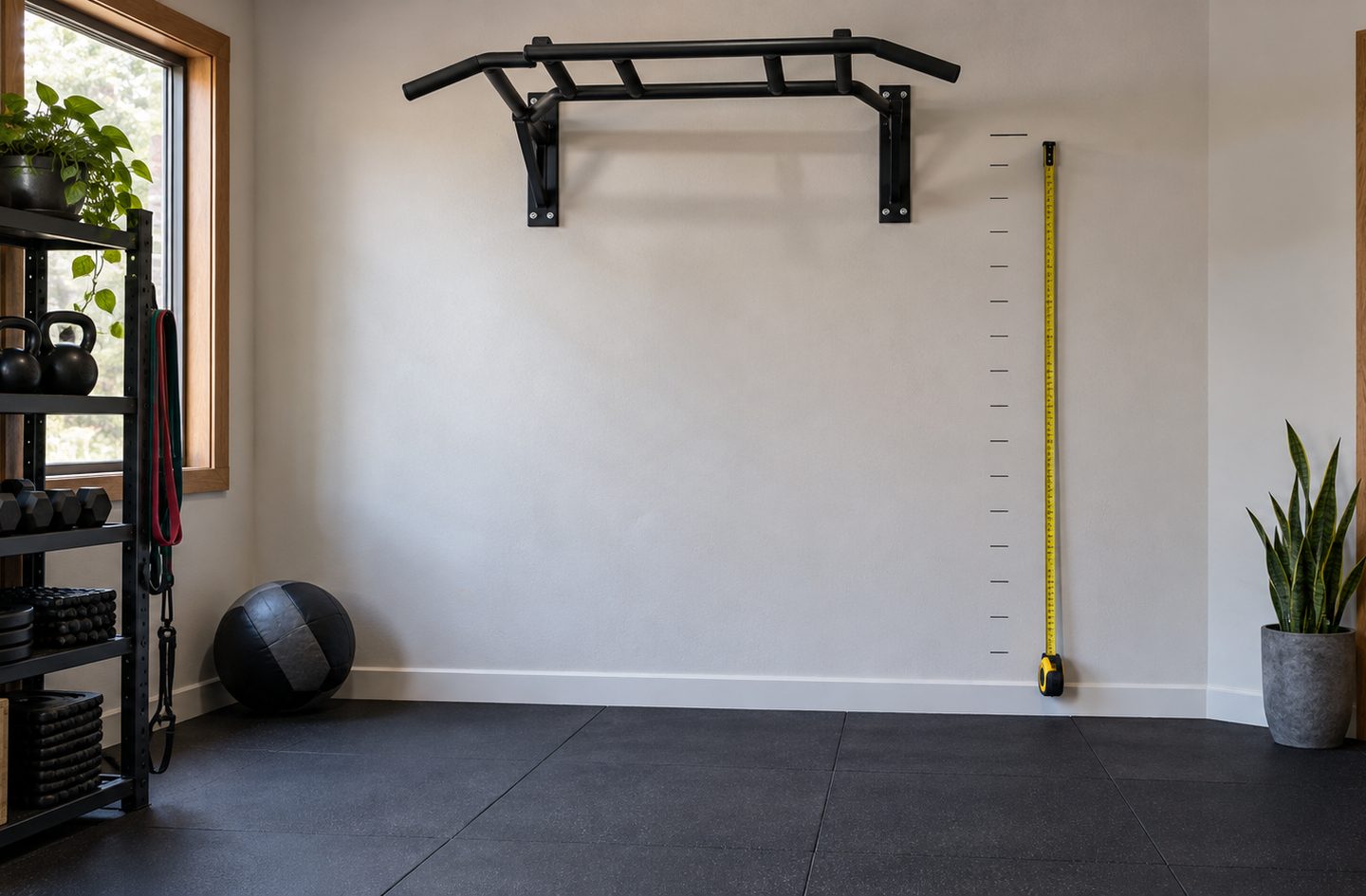
Stand barefoot or in the shoes you train in on a flat surface. Extend both arms straight overhead, fingers together. Have a helper mark the wall or hold a tape measure at the highest fingertip point. The floor-to-fingertip distance in this position is your overhead reach.
By the end of this step, you have the single most important number in the pull-up bar height calculation.
What the Population Numbers Look Like
The average US adult male stands 68.9 inches tall.1 At the 50th percentile, male overhead reach sits at 82.5 inches (6 feet 10.5 inches) from the floor, with 5th-percentile reach at 74.0 inches and 95th-percentile reach at 86.9 inches (7 feet 2.9 inches).2 For women at the 50th percentile, overhead reach sits at 78.4 inches (6 feet 6.4 inches).2 Your own number is the one to use. These figures tell you where you sit relative to the population, but the bar height is personal.
A rough rule, derived from the DoD Ergonomic Working Group data: functional overhead reach runs approximately 1.2 times standing height for adults.2 A person who stands 5 feet 10 inches (70 inches) tall should expect an overhead reach near 84 inches. British adult data sourced from BS EN ISO 14738 shows similar ranges: male 50th-percentile vertical reach at 82.7 inches and female at 76.4 inches, consistent with the US figures.3 Use this estimate if a direct measurement isn’t available yet, then verify before committing to a mounting location.
What Reach Tells You About Bar Height
The overhead reach is your dead-hang floor: with the bar at exactly your reach height, your fingertips touch the bar when your arms are fully extended and your feet are just off the ground. Setting the bar slightly above your reach (by 1 to 3 inches) gives grip clearance and keeps feet off the floor with a comfortable margin. Setting the bar below your reach forces a bent-knee hang from the start of every set.
There is nothing wrong with a bent-knee hang. Many home gym setups use a bar at 7 feet (84 inches) even when the tallest user has a reach of 86 or 87 inches. The legs fold up and the movement is identical. What changes is the feel of the rep and the option to do straight-leg movements like toes-to-bar. If those exercises matter to your training, the bar needs to be above your full reach. If not, a lower bar works fine.
Step 2: Set the Bar Height for Your Training Style
With your overhead reach measured, you have two viable bar-height strategies. The right choice depends on what you train, not on a universal standard.
Strategy A: Bar at or Above Your Reach (Full Dead-Hang)
Place the bar 1 to 3 inches above your overhead reach. For an average-height male with a 82.5-inch reach, a bar at 84 inches (7 feet) delivers a full straight-arm dead-hang with a few inches of clearance underfoot. For taller users – say, someone with a reach of 87 inches – a 7-foot bar means bent knees. They need a bar at 88 to 90 inches to hang with legs straight.
This strategy works well for kipping pull-ups, toes-to-bar, and any movement where a full hang position is the start point. Wall-mounted bars, rack-integrated bars, and power-tower bars are all available at this height range. If you’re checking rack clearance as part of a larger power rack purchase, the power rack ceiling clearance overview covers the full bar-to-ceiling budget for rack-integrated bars specifically.
Strategy B: Bar Below Your Reach (Bent-Knee Hang)
Place the bar at a height where you grip the bar with arms overhead and immediately bend your knees to clear the floor. This is the most common setup in rooms with 8-foot ceilings because the clearance budget above the bar is tight at higher positions. A bar at 80 to 83 inches works for users with an 84 to 87-inch reach who don’t need a straight-leg hang. The motion is unchanged for standard pull-ups and chin-ups.
The trade-off: leg raise progressions, L-sits, and toes-to-bar all require a fully extended body in the hang position. A bar set below your reach makes these movements more difficult or impossible. Plan for these exercises now if they’re part of your long-term training, even if you’re starting with basic pull-ups.
Step 3: Check the Headroom Above the Bar
Setting the bar at the right height for your hang is only part of the calculation. The space above the bar matters too, and this is the step most home gym setups skip.
Why the Space Above the Bar Matters
At the top of a pull-up, your chin and upper chest rise above the bar. For a chin-over-bar rep, your head clears the bar by several inches. Add the dynamic bounce of a kipping rep or the reach at the top of a muscle-up, and the clearance demand above the bar grows further. An overhead obstruction – a beam, a garage door track, or a low ceiling – inside this zone stops the movement or creates a genuine safety hazard.
The Whole Building Design Guide, published by the National Institute of Building Sciences as a federal interagency resource for building professionals, states:
“A minimum 12′ ceiling height is generally required in exercise rooms to accommodate the clearances needed for daily equipment usage.”
WBDG, National Institute of Building Sciences – Physical Fitness (Exercise Room) space type4
A 12-foot ceiling puts the bar well below the ceiling for most residential users. In a home gym with a standard 8- or 9-foot ceiling, the 12-foot benchmark doesn’t apply directly. What translates from professional facility guidance to home gym planning is the principle: measure the clearance above the bar, not just the bar height from the floor. The NSCA’s facility design curriculum similarly recommends 12 to 14 feet of ceiling clearance in training areas to accommodate the full range of overhead movements.5
The 12-Inch Floor and the 20-Inch Target
For a home gym, practitioner guidance points to two figures. Minimum 12 inches of clearance above the bar accommodates a standard chin-over-bar pull-up for most users.6 Twenty inches is the preferred target – enough room for a comfortable chin-over-bar position, some dynamic movement, and a safety margin if the bar is mounted on the underside of a rack or power tower with a non-padded ceiling above.
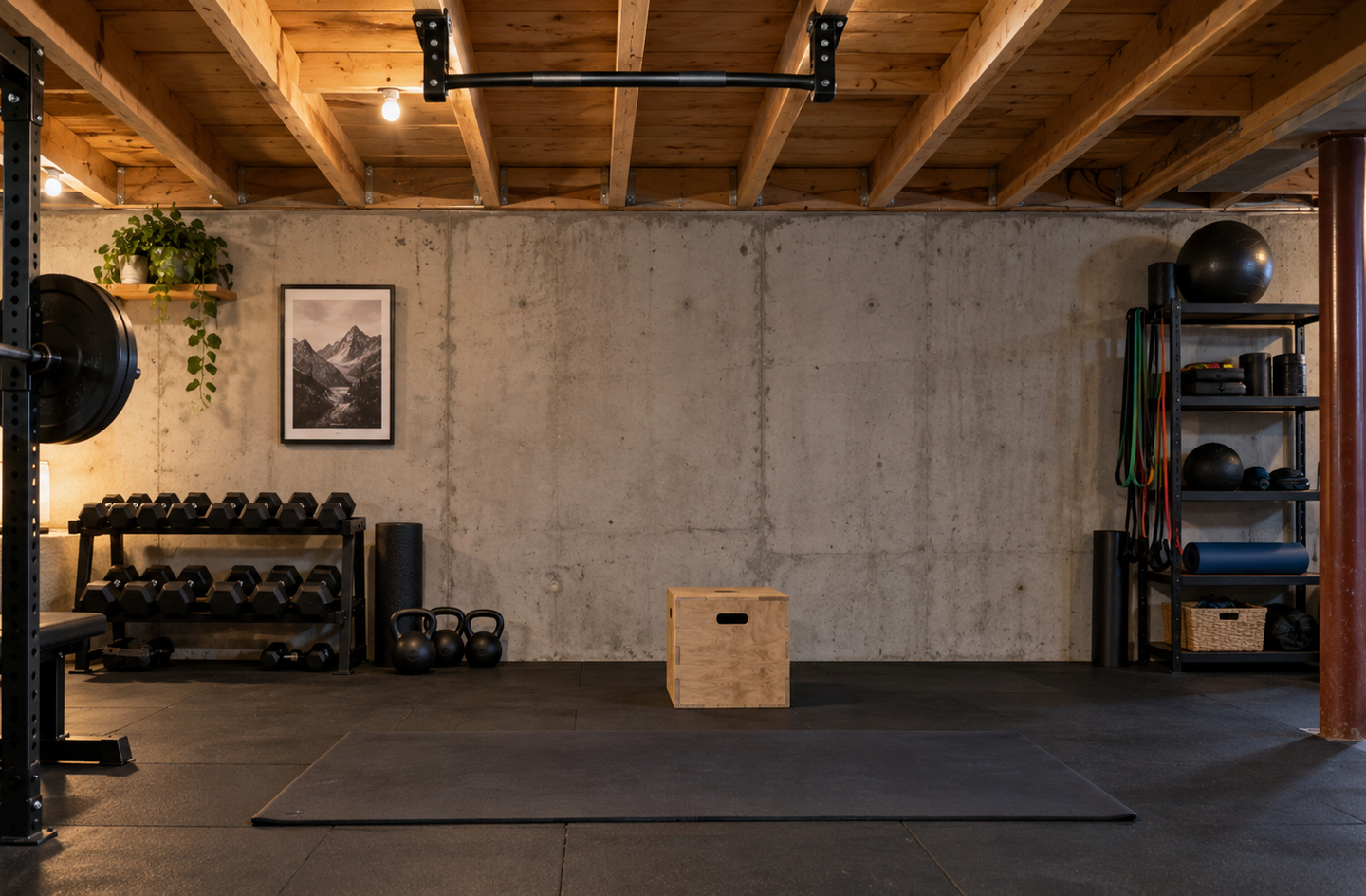
To find your above-bar clearance: subtract the bar height from your effective ceiling height. Effective ceiling height is the room ceiling minus floor mat thickness. On a 9-foot ceiling (108 inches) with a 3/4-inch rubber mat, effective ceiling is 107.25 inches. A bar at 84 inches leaves 23.25 inches above the bar – comfortably above the 20-inch target. A bar at 90 inches in the same room leaves 17.25 inches, which meets the 12-inch minimum but falls short of the preferred 20 inches.
How High Should a Pull Up Bar Be: Running the Full Budget
The full calculation connects all three measurements into one check. Work through the steps in order:
- Effective ceiling height = room ceiling height minus floor mat thickness
- Maximum bar height = effective ceiling height minus minimum above-bar clearance (12 inches absolute floor; 20 inches preferred)
- Minimum bar height = your overhead reach (or the tallest user’s reach in the household)
- Viable bar zone = from minimum bar height up to maximum bar height
If the viable bar zone has no room – if the maximum bar height falls below the minimum bar height – the ceiling is too low for a full dead-hang pull-up at the 12-inch minimum clearance. The options then are a thinner floor mat, a lower bar with bent-knee hangs, or a different exercise.
What the Numbers Look Like for Common Ceiling Heights
The table below runs the full budget for the three most common residential ceiling heights with a standard 3/4-inch rubber mat.7 New residential construction commonly delivers 9 feet on main floors; the IRC 2024 sets the minimum habitable ceiling at 7 feet, which is a code floor, not a home gym planning target.8 The bar height column shows a typical installation choice for each ceiling, and the above-bar column shows what remains.
| Ceiling Height | Floor Mat | Effective Ceiling | Bar Height | Above-Bar Room | Notes |
|---|---|---|---|---|---|
| 8 ft (96 in) | 3/4 in | 95.25 in | 84 in (7 ft) | 11.25 in | Below the 12-inch minimum; use a thinner mat or lower bar for more clearance above |
| 9 ft (108 in) | 3/4 in | 107.25 in | 84 in (7 ft) | 23.25 in | Comfortable for most home gym users; above-bar room exceeds the 20-inch target |
| 10 ft (120 in) | 3/4 in | 119.25 in | 90 in (7.5 ft) | 29.25 in | Suitable for taller users; higher bar placement is possible without sacrificing clearance |
The 8-foot scenario is the most constrained. With a standard 3/4-inch mat and a 7-foot bar, the above-bar room drops below the 12-inch minimum. Two fixes work here: switch to a thinner mat (3/8-inch or 1/2-inch for a pull-up-only zone, which doesn’t need the impact absorption of a heavy-lifting area) or mount the bar at 81 to 82 inches so the above-bar clearance reaches 13 to 14 inches. The second fix means bent-knee hangs for average-height users, which is acceptable for standard pull-ups but limits straight-leg movements.
An original analysis of the DoD anthropometric data and these ceiling scenarios shows one non-obvious result: on an 8-foot ceiling with a standard mat, no bar position simultaneously allows a straight dead-hang for an average-height male AND meets the 12-inch above-bar minimum. The geometry forces a choice. A 9-foot ceiling resolves the conflict entirely.
Common Pull-Up Bar Height Mistakes
Most pull-up bar height errors fall into a small set of repeatable patterns. The same mistakes appear in basement builds and garage conversions alike.
Mounting at Shoulder or Chest Height
Some first-time installations land the bar at shoulder height or just above the head – the height where the bar is easy to reach from standing. This creates a bar too low for any meaningful hang. You end up performing a standing-start pull from bent elbows rather than a full dead-hang repetition. The fix is to measure overhead reach before installation, not eyeball the position while standing next to the wall.
Skipping the Above-Bar Check
Setting bar height based only on the distance from the floor misses half the calculation. A bar at 84 inches in a room with an 8-foot ceiling and a 3/4-inch mat leaves 11.25 inches above the bar – less than the 12-inch minimum for comfortable chin-over-bar clearance. Many home gym builders install the bar first, test it, and then discover the ceiling is uncomfortably close at the top of each rep. Measure the clearance above the bar as part of the planning step, not after installation.
Measuring the Room Ceiling Without Accounting for Floor Thickness
A 9-foot ceiling sounds like plenty of room until rubber mats, a deadlift platform, or a raised wooden platform adds 1 to 4 inches of height underfoot. The effective ceiling is the room ceiling minus floor thickness. A 9-foot ceiling with 1.5 inches of flooring delivers an effective ceiling of 106.5 inches. A bar at 84 inches leaves 22.5 inches above it – still comfortable, but 0.75 inches less than the 3/4-inch-mat scenario in the table above. On an 8-foot ceiling with 1.5 inches of flooring, the effective ceiling drops to 94.5 inches, leaving just 10.5 inches above a 7-foot bar. The habit of subtracting floor thickness from ceiling height before any other calculation prevents this error.
Installing at One Height for Multiple Users
A household with users ranging from 5 feet 4 inches to 6 feet 2 inches faces a real mismatch if the bar height is optimized for one person. The taller user with a 90-inch reach needs the bar higher. The shorter user with a 78-inch reach needs bent knees at the same bar. One solution: install the bar for the tallest user’s dead-hang needs and have shorter users bend their knees. Another: choose a power tower or rack with adjustable bar height so the position shifts between users. Either way, decide before installation – not after the bar is bolted to the wall.
Frequently Asked Questions
What ceiling height does a home gym need for pull-ups?
A 9-foot ceiling is the practical minimum for a comfortable 7-foot bar setup with a standard 3/4-inch mat, leaving about 23 inches of clearance above the bar. An 8-foot ceiling works but leaves under 12 inches of clearance with a standard mat installed.4 Measure the actual ceiling height at the bar’s planned location before choosing a mount type.
How high from the floor should a pull-up bar be for a dead-hang?
For a straight-arm dead-hang with feet off the floor, set the bar at or slightly above your overhead reach. The average US male overhead reach at the 50th percentile is 82.5 inches; a bar at 84 inches (7 feet) gives 1.5 inches of clearance above the fingertip reach.2 Measure your own reach standing in your training shoes before committing to a height.
How much clearance is needed above a pull-up bar?
Minimum 12 inches of clearance above the bar supports standard chin-over-bar pull-ups for most users.6 Twenty inches is the preferred target. Below 12 inches, the ceiling or an overhead obstruction is close enough to contact during the upward phase of a rep, particularly for taller users or any kipping movement.
Does a pull-up bar work in a room with an 8-foot ceiling?
An 8-foot ceiling with a standard 3/4-inch mat and a 7-foot bar leaves 11.25 inches of clearance above the bar – below the 12-inch practitioner floor. A thinner mat (3/8 to 1/2 inch, sufficient for a pull-up-only zone) restores the gap to 12 to 13 inches.7 Strict pull-ups at a bent-knee hang work for most average-height users in this setup.
What pull-up bar height works for users of different heights in the same household?
Set the bar for the tallest user’s overhead reach. For a household ranging from 5 feet 4 inches to 6 feet 2 inches, a bar at 90 inches (7.5 feet) supports the taller user’s full dead-hang while shorter users bend their knees to clear the floor. Both perform the same pull-up movement; only the starting hang position differs.
Limitations and Edge Cases
- The overhead reach figures in this article draw on US adult anthropometric data from the DoD and CDC;2 populations outside the US differ slightly from these benchmarks.
- Beam, duct, light fixture, and garage door hardware locations are not captured by a basic ceiling height measurement; measure the actual obstruction height at the bar’s exact planned position, not an adjacent clear zone.
- Adjustable-height setups (rack-integrated or wall-mounted bars with multiple hole positions) change the decision: the ceiling sets the maximum and the tallest user’s reach sets the minimum, with the bar placed anywhere in between.
References
- CDC NCHS – Body Measurements Fast Stats: mean height for US adults ages 20 and older, National Health and Nutrition Examination Survey, August 2021 – August 2023.
- U.S. DoD DENIX Ergonomic Working Group – Anthropometric Guidelines: standing functional overhead reach percentiles for adult males and females; sourced from NASA 1978 Anthropometric Source Book and ANSUR military databases; posted 2016.
- RoyMech – Human Body Dimensions and Anthropometric Data: vertical reach percentiles for British adults derived from BS EN ISO 14738 and related ergonomic standards.
- WBDG (National Institute of Building Sciences) – Physical Fitness (Exercise Room) space type: minimum ceiling height requirements for exercise facility design.
- PTPioneer – NSCA CSCS Chapter 23: Facility Design, Layout, and Organization; ceiling height guidance for fitness training areas; 12 to 14 feet of clearance recommended.
- BodySpec – Pull-Up Bar Buyer’s Guide: minimum head clearance guidance for pull-up bar installation; 12 inches minimum above the bar recommended.
- IronCompany – Home Gym Flooring Guide: rubber mat thickness by training activity; 3/4-inch thickness standard for heavy lifting zones.
- Jaspector – IRC 2024 Section R305.1: minimum habitable space ceiling height of not less than 7 feet for residential construction; 2024 International Residential Code.
Conclusion
Pull-up bar height from the floor is a three-part calculation: your overhead reach sets the minimum, your ceiling minus floor thickness sets the available space, and the 12-to-20-inch clearance above the bar determines where the bar fits within the range. A 9-foot ceiling resolves the geometry for most home gym users without compromise. An 8-foot ceiling requires a deliberate trade-off between mat thickness, bar height, and above-bar clearance.
For the broader overhead clearance picture across all equipment and movements in your room, see the overview in Home Gym Ceiling Clearance.