The bar hits the ceiling on the first overhead press. The rack ships and does not fit. The treadmill installs and leaves no headroom at full stride. These happen because equipment gets ordered before the room gets measured. A low ceiling home gym works at 7, 8, or 9 feet when the plan starts with what the room allows, not what the spec sheet promises. The Home Gym Ceiling Clearance overview covers the full topic. This article works through the specific decisions: which racks, cardio machines, cable stations, and movement patterns fit a restricted vertical envelope, and which ones require changes before the first session. The International Residential Code sets 7 feet as the minimum ceiling height for any habitable basement space.1 That is the building-code floor for every planning decision below.
Quick Answer
A low-ceiling home gym works from 7 to 9 feet when every piece of equipment and every exercise in the training plan fits within the room’s real headroom. The IRC minimum for a habitable basement ceiling is 7 feet.1 At that height, short racks, bench work, cable training, and floor movements all fit. Standing overhead press and indoor jump rope do not clear for most users: jump rope alone requires a minimum 9-foot ceiling per Crossrope’s guidance.4 An 8-foot room opens up pull-ups on a short rack for users under 5 feet 10 inches. A 9-foot room accommodates most training programs without changes.
Key Takeaways
- The IRC minimum for a habitable basement ceiling is 7 feet. Non-habitable zones drop to 6 feet 8 inches, and beams within those areas permit to project to 6 feet 4 inches from the finished floor.1
- Power racks range from 71 to 101 inches in frame height; most standard full-size models cluster near 90 inches.2 Short racks run 72 to 80 inches and are the right starting point for any ceiling under 9 feet.
- A standard treadmill deck elevates the user 8 to 10 inches; a high-incline trainer reaches up to 15 inches at maximum pitch.3 That elevation compounds directly onto user height in the ceiling calculation.
- Indoor jump rope requires a minimum 9-foot (108-inch) ceiling, making it the most clearance-demanding activity in most home gym layouts.4
- A record 77 million Americans held gym memberships in 2024, up 20 percent from 2019.5 Meanwhile, 21 percent of Americans now report a dedicated home gym versus 18 percent with a gym membership.6 Getting the ceiling clearance right before the first purchase keeps the home setup from becoming a costly rework.
- The governing constraint in any room is the tallest movement you plan to perform, not the tallest equipment you plan to buy.
Before You Start: Measure the Ceiling You Actually Have
The figure that matters for a low-ceiling home gym is not the floor-to-ceiling height at the doorway. Beams, ducts, pipes, and garage door hardware reduce the effective height at specific spots, sometimes by 6 inches or more. A room with an 8-foot ceiling at the door and a beam 7 feet 4 inches above the planned rack position has 7 feet 4 inches of usable clearance for that zone.
Usable clearance is the vertical distance from the finished floor surface to the lowest overhead obstruction at the exact spot where each piece of equipment or movement will be used. The finished floor, not the subfloor: rubber mats and raised platforms come off that measurement first.
Before any equipment decisions, gather four measurements at the planned training zones:
- Above the rack uprights, at the spot where the frame will stand
- Above the cardio footprint, where the user’s head will be at maximum stride or incline
- Above the open floor zone used for floor-based work and any overhead movements
- Above the cable or pull-up position, where the bar or top pulley will sit
Use a tape measure long enough to reach a 9-foot ceiling and a flashlight to spot overhead obstructions before measuring through them. Record the lowest number from each zone. That smallest figure is the operative ceiling height for planning, and every equipment decision in this article works from it.
The International Residential Code sets the regulatory baseline:
“Habitable space, hallways, bathrooms, toilet rooms, laundry rooms, and portions of basements containing these spaces shall have a ceiling height of not less than 7 feet (2134 mm).”1
International Code Council, International Residential Code Section R305.1
Non-habitable basement areas may be as low as 6 feet 8 inches, and structural elements such as beams or girders within those zones permit to project down to 6 feet 4 inches from the finished floor.1 A dedicated training room qualifies as habitable space, so the 7-foot minimum applies. Measuring below that number means the room does not meet the code minimum for a habitable use before any equipment enters the picture.
The operative ceiling height for every purchase decision in a low-ceiling home gym is the smallest number from any measurement zone, taken at finished floor level, directly above the specific spot where each piece of equipment or movement will be used. Nothing else drives the decision.
Step 1: Identify the Governing Constraint Before Buying Anything
Most people select a rack, then measure to see if it fits. That is the wrong order. The rack fits or does not fit based on what the user plans to do inside it and around it. A rack that clears the ceiling by 4 inches for squats and bench press becomes unusable the first time a standing overhead press is attempted if the bar path at lockout contacts the ceiling 3 inches above the frame.
The equipment envelope is the maximum vertical height reached by the combined system of user, equipment, and movement during any exercise. For a squat, the envelope is the height of the loaded barbell resting in the J-cups. For a standing overhead press, the envelope is the height of the bar at full lockout, which rises well above the lifter’s standing height when the arms are extended overhead. The envelope is always larger than the equipment’s listed frame height whenever the user or the barbell travels above the frame during the exercise.
Work through the highest-clearance movements in your planned training menu in descending order of ceiling demand:
- Indoor jump rope: rope arc travels above head height. Crossrope recommends a minimum 9-foot (108-inch) ceiling for indoor use with their standard rope size.4
- Box jumps: the jump arc on a 24-inch box pushes combined height past 9 feet for most users.
- Standing barbell overhead press: bar at lockout sits above fully extended arms. For a 5-foot 10-inch lifter, lockout reaches approximately 88 to 90 inches above the floor, and the bar adds further height above the grip.
- Pull-ups on a rack bar at 90 inches: the pull-up bar on a standard full-size rack sits at 90 inches.2 The user’s head clears the bar at the top, requiring ceiling clearance above bar position.
- Treadmill at maximum incline: a high-incline trainer raises the user up to 15 inches above floor level at maximum pitch, adding directly to standing height.3
- Standard treadmill at flat: deck elevates the user 8 to 10 inches above the floor.3
If the ceiling clears none of these movements, the planning path is clear: eliminate or adapt them before any equipment is ordered. If some clear and some do not, the failing ones become the exercises addressed in Step 5 below. Either way, establishing the governing constraint is the first step, and it takes a tape measure, not a purchase.
The governing constraint for every other equipment and exercise decision is the tallest movement in your training plan. Establish that number first and every other choice becomes a straightforward fit or elimination.
Step 2: Power Rack Options for a Low Ceiling Home Gym
Rack selection in a low-ceiling home gym involves three separate checks: the frame height against the ceiling, the pull-up bar position against the user’s hang clearance, and the inside-rack bar path at lockout against the ceiling directly above the lifter’s standing position during a press. Each is independent, and all three need to pass for the rack to work in the room.
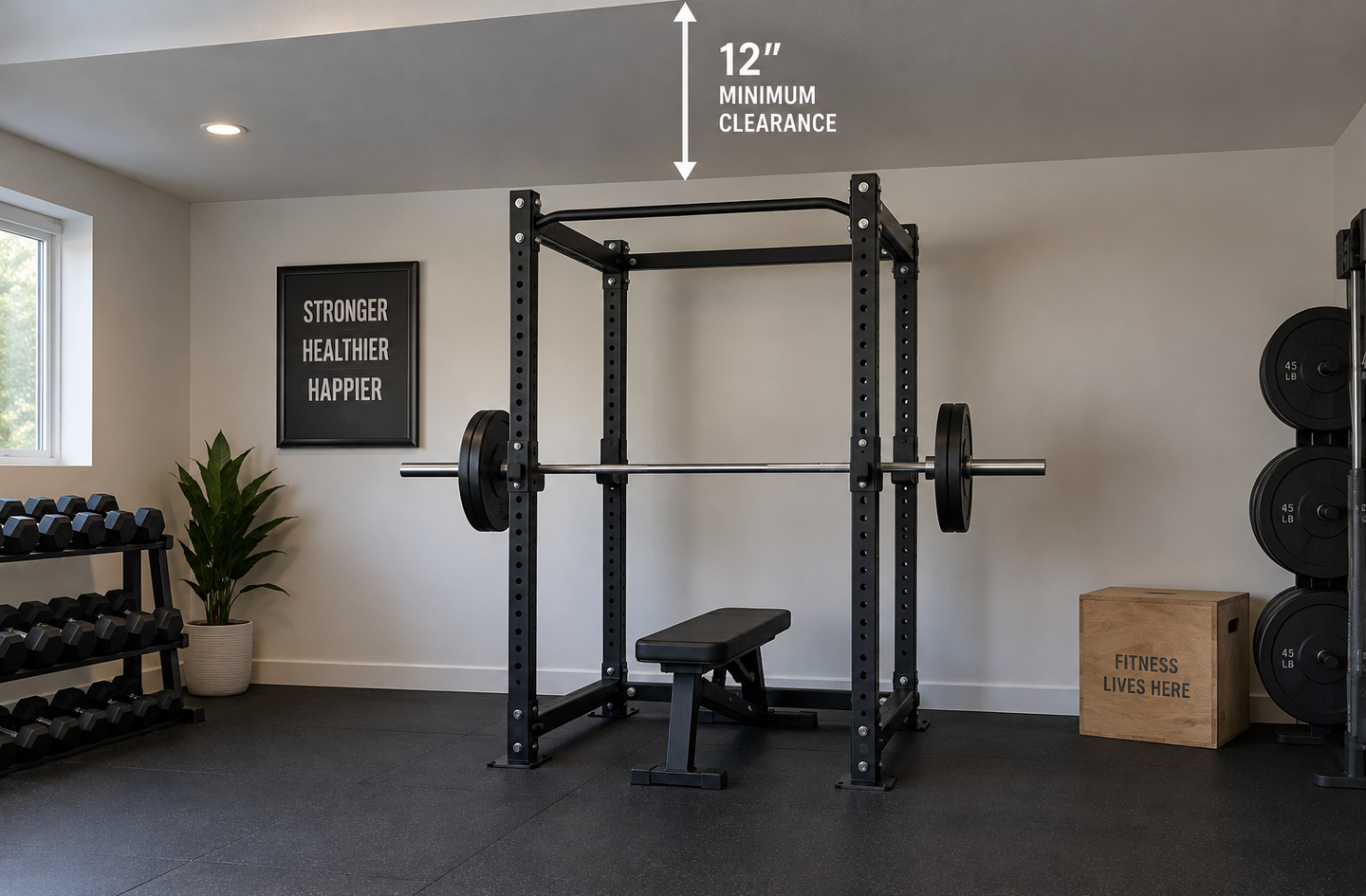
Short power racks are frames engineered specifically for ceiling-limited spaces, typically standing 72 to 80 inches to the top of the uprights. Standard full-size rack frames run from approximately 90 inches to over 100 inches tall, with most models clustering near the 90-inch mark.2 Power racks across the full market range from 71 to over 101 inches in total frame height.2
The table below maps each ceiling height against what fits and what does not for a 6-foot reference user:
| Ceiling Height | Short Rack (72-80 in) | Standard Rack (90+ in) | Pull-Ups on Top Bar | Standing Barbell Press |
|---|---|---|---|---|
| 7 ft (84 in) | Frame fits (4-12 in above) | Does not fit | Not viable at this height | Not viable |
| 8 ft (96 in) | Frame fits (16-24 in above) | Marginal (6 in above frame) | Short rack bar: viable for users under 5’10” | Check the bar path specifically |
| 8.5 ft (102 in) | Fits with clearance | Frame fits (12 in above) | Viable on both for most users | Possible; verify bar path at lockout |
| 9 ft (108 in) | Fits with margin | Fits (18 in above frame) | Viable on both | Viable with room to spare |
At 7 feet, a short rack at 80 inches leaves 4 inches above the frame. Pull-ups are not viable for a 6-foot user at this height. The room supports squats, bench, deadlifts, and barbell rows without overhead problems. At 8 feet, the short rack at 80 inches leaves 16 inches above the frame, which allows a bent-knee dead-hang for a 6-foot user. A standard 90-inch rack at 8 feet leaves only 6 inches above the frame: the frame fits, but full-range pull-ups do not.
The bar path during an overhead press is a separate check from frame height. Even if the rack frame clears the ceiling, the lockout position above the lifter’s head may not. Check the ceiling directly above the lifter’s standing position inside the rack. For a full breakdown by specific rack model, see the power rack ceiling clearance guide.
The 8-foot ceiling is the practical pivot point. A short rack fits most pressing and pulling patterns at 8 feet. A standard rack becomes viable at 9 feet. A 7-foot room limits the rack role to squats, bench, and barbell rows without overhead work.
Step 3: Cardio Equipment That Works Under a Low Ceiling
Cardio equipment introduces a variable that racks do not: the platform or deck raises the user above the floor before the user’s own height comes into the clearance calculation. On a rack, the lifter stands on the floor. On a treadmill, the lifter stands on a belt that is itself elevated above the floor.
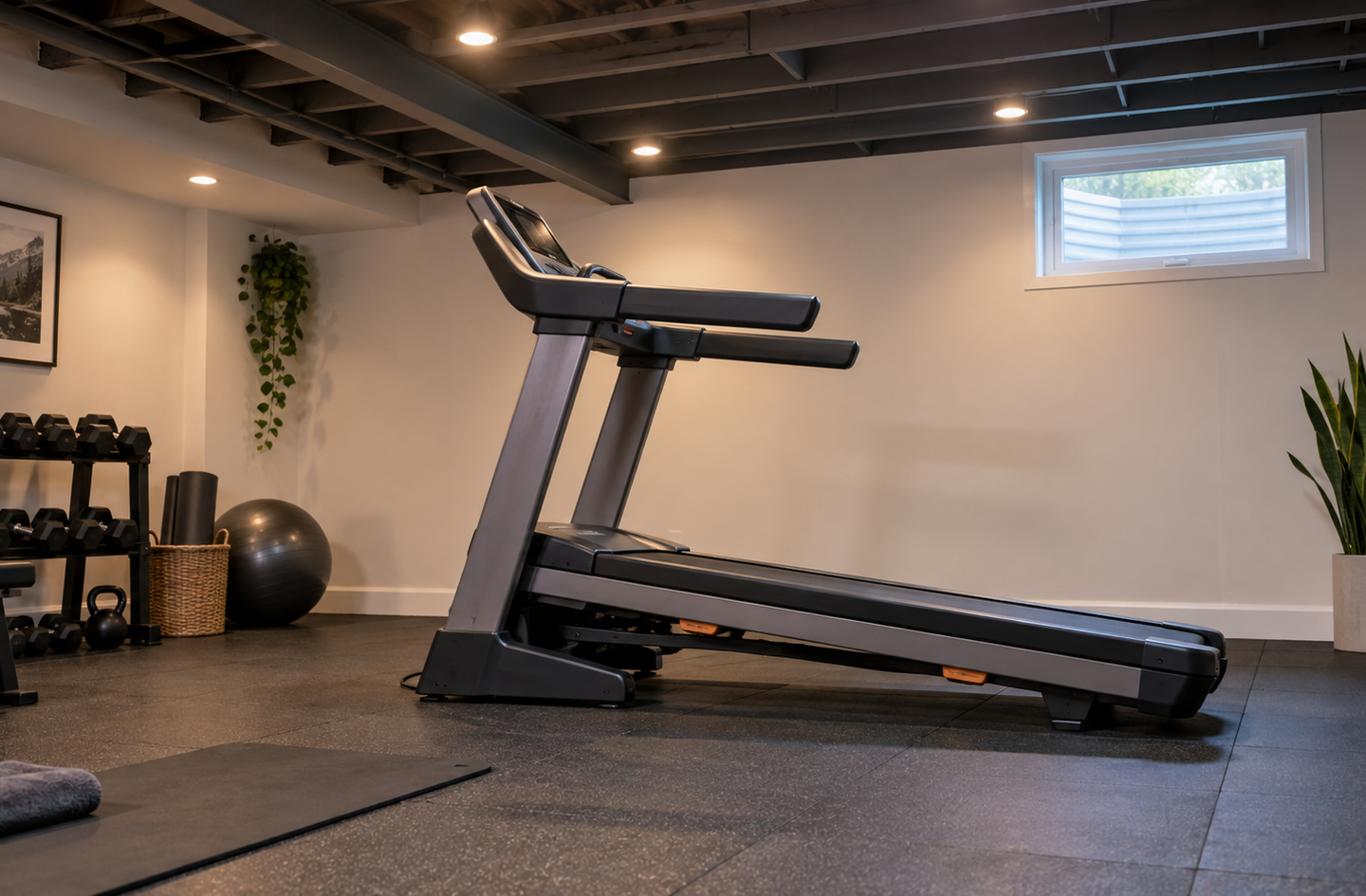
Deck elevation is the height of a treadmill’s running surface above the floor at the rear of the machine, where the user stands. Standard residential treadmills run 8 to 10 inches of deck elevation.3 High-incline trainers reach up to 15 inches at maximum pitch.3 That elevation adds directly to the user’s standing height for the purpose of ceiling clearance calculation.
The planning formula for a treadmill: user height in inches, plus deck elevation, plus a 4-inch safety buffer for walking. For a 5-foot 10-inch user (70 inches) on a standard 8-inch deck: 70 plus 8 plus 4 equals 82 inches, which fits within an IRC-compliant basement. The same user on a high-incline trainer at maximum pitch: 70 plus 15 plus 4 equals 89 inches, which requires more than 7 feet of usable clearance.
Equipment that fits under restricted ceilings without a calculation: upright stationary bikes (50 to 60 inches seated), recumbent bikes (40 to 50 inches), and rowing machines (seated and forward-leaning, well below 60 inches at all stroke phases). These sidestep the deck-elevation problem entirely.
Equipment that requires the formula before purchase: standard treadmills (run the user height plus deck plus buffer), high-incline trainers (15-inch deck at max pitch pushes the requirement well past 8 feet for most users), and ellipticals with elevated stride (check step-up height the same way).
Bikes and rowers sidestep the deck elevation problem. For a low-ceiling room, they are the default cardio starting point. A treadmill becomes a calculated selection based on the actual user height, the actual machine’s deck height, and the actual room clearance at the specific placement location.
Step 4: Cable Stations and Pull-Up Bars in a Low-Ceiling Room
Both cable stations and pull-up bars require a clear zone above the highest operating point, either the top pulley or the bar itself. Compact or short-frame cable stations run 76 to 82 inches in total height. In a 7-foot room, a unit at 78 inches leaves 6 inches above the frame, and lat pulldowns work. For overhead cable movements, check the attachment’s top position against the ceiling separately from the frame height.
Pull-up bar clearance is driven by bar position plus head clearance at the top of the movement. A bar at 80 inches with 12 inches of headroom requires 92 inches of ceiling. A 5-foot 10-inch user at 80 inches can dead-hang; a 6-foot 2-inch user will need to tuck the knees. Full bar height, hang clearance, and headroom calculations are in the pull-up bar height guide.
In a 7-foot room, cable lat pulldowns replace bar pull-ups for users 6 feet or taller. In an 8-foot room, a wall-mounted bar at 80 to 84 inches works for users under 5 feet 10 inches.
Cable pull-down work fits in nearly any low-ceiling room with a compact machine. Bar pull-ups require matching bar height to hang reach, with ceiling clearance above the bar as a separate check.
Step 5: Adapt These Movements Before the First Session
Once the ceiling eliminates a movement from the planned training menu, the task is finding a replacement that trains the same pattern at a lower height. The ceiling removes the specific exercise. The training goal remains.
Standing Overhead Press
For a 5-foot 10-inch user, standing press lockout reaches approximately 88 to 90 inches above the floor. In a 7-foot room that contacts the ceiling for most users. Three direct replacements:
- Seated barbell or dumbbell press: seated lockout drops bar height by 18 to 24 inches, putting lockout within an 8-foot ceiling for most users.
- Kneeling press: reduces lockout height further, to approximately 72 to 76 inches for a 5-foot 10-inch lifter.
- Landmine press: bar travels forward at an angle; lockout stays well below vertical press height and clears nearly any residential ceiling.
All three train shoulder pressing through the same pattern. The ceiling removes the standing version, not the goal.
Pull-Ups and Chin-Ups
When the bar cannot be positioned high enough, a seated lat pulldown on a compact cable station is the direct replacement. It trains the same shoulder adduction and elbow flexion pattern, requires no overhead clearance from the user, and fits within a 7-foot room. Straight-arm pulldowns, single-arm cable rows, and face pulls on the same machine cover the remaining upper back work.
Box Jumps and Indoor Jump Rope
Box jumps on a 24-inch box push the combined peak height past 9 feet for most users. Replacements: step-ups (same single-leg pattern, no jump arc), broad jumps (travel forward, stay well within ceiling height), and trap bar deadlifts (hip extension power, no vertical clearance needed).
Indoor jump rope requires a minimum 9-foot ceiling by Crossrope’s guidance.4 At 7 or 8 feet, the rope contacts the ceiling before form breaks down. Floor-level alternatives: lateral shuffles, mountain climbers, high-knee running in place, and footwork ladder drills.
No ceiling height eliminates a training goal. Every goal has an expression that works within the room’s limits. Running through this substitution list before ordering any equipment is what keeps the training plan from colliding with the room on the first day of use.
Three Planning Mistakes That Add Up Fast
As home training has grown, ceiling clearance has become one of the most common sources of avoidable rework. Three mistakes appear regularly.
Measuring at the Doorway, Not Above the Equipment
Most people measure ceiling height at the center of the room or entry point, where the ceiling is typically highest. In basements, structural beams often run directly above where a rack will sit. In garages, door tracks and hardware hang from the ceiling in the zone where taller equipment lands. Measure at each of the four training zones from the measurement section above. The beam no one checked is the one the pull-up bar contacts on rep one.
Using Frame Height Instead of Operating Clearance
A rack’s specification sheet lists frame height: floor to top of uprights. Frame height does not include the barbell path during a press, loaded plates above the J-cup position, or range of motion above the frame during overhead work. Operating clearance equals frame height plus whatever the barbell and plates add above the top of the uprights. A rack that passes the frame-height check can still fail on bar path.
Ignoring Flooring and Platform Thickness
Rubber stall mats run 3/4 inch to 1 inch thick per layer. A deadlift platform stacks 1.5 to 2.5 inches above the subfloor. Flooring and platforms consume ceiling clearance from below, not above. In a 7-foot room with a short rack at 80 inches, a 1.5-inch platform shifts the effective frame height to 81.5 inches and cuts the ceiling gap to 2.5 inches. Measure from the finished floor surface, including all flooring layers, every time.
Each of these mistakes is corrected by one tool and ten minutes: a tape measure at the finished floor, at the exact training location, before any equipment is ordered. Clearance is equipment.
Frequently Asked Questions
What ceiling height does a home gym need?
The International Residential Code sets 7 feet as the minimum for a habitable basement space.1 In practice, 8 feet is the functional minimum for a short rack, bench work, cable training, and a flat treadmill for most users. Nine feet opens standard rack pull-ups, standing press with practical margin, and jump rope, which requires 9 feet as a minimum regardless of other equipment.4
What gym equipment fits in a 7-foot ceiling?
At 7 feet (84 inches), short power racks (72 to 80 inches) fit with a small clearance above the frame.2 Flat and incline benches, dumbbells, barbell work at hip and shoulder height (squats, rows, deadlifts, bench press), compact cable machines under 80 inches, upright bikes, rowers, and all floor-based movements fit without issue. A standard treadmill on zero incline fits for users under 5 feet 10 inches with a minimal buffer; taller users and any incline push the requirement above 7 feet.
Can you do pull-ups with an 8-foot ceiling?
Yes, with a wall-mounted or rack-integrated bar at 80 to 84 inches. At 8 feet, a bar at 84 inches leaves 12 inches above it. A 6-foot user can full dead-hang at 84 inches with feet off the floor; users taller than 6 feet may need to tuck the knees. For users over 6 feet 2 inches, a cable lat pulldown on a compact machine is the practical replacement.
How do I replace standing overhead press in a low-ceiling home gym?
A seated dumbbell or barbell overhead press drops the lockout position by 18 to 24 inches compared to a standing press. For most users in a low-ceiling room, seated press fits within an 8-foot ceiling with margin. A kneeling press drops it further. A landmine press keeps the bar on a forward-angled path rather than a vertical one, and the lockout position stays below shoulder height of the standing lifter, which fits within nearly any ceiling height. All three train the same shoulder pressing pattern.
Does a treadmill require more ceiling height than a power rack?
It depends on the user’s height. A standard treadmill deck elevates the user 8 to 10 inches above the floor.3 Adding a 4-inch buffer, a 5-foot 10-inch user needs approximately 82 inches. That is just under the 7-foot mark, meaning a flat treadmill fits in most rooms where a short rack fits. A high-incline trainer at maximum pitch raises the user up to 15 inches above the floor,3 requiring approximately 89 inches for the same user. A short 80-inch rack at an 8-foot ceiling fits with more margin than an incline trainer does for users over 5 feet 10 inches.
Limitations and Edge Cases
- This article addresses standard flat-ceiling home gyms. Sloped ceilings in attic, bonus-room, and roofline spaces require zoning the room by measured height and assigning each equipment category to the zone that clears it.
- User height examples use 5 feet 10 inches and 6 feet as references. The formulas apply to any height: substitute the actual user’s measurement. Shorter users gain margin across all categories; taller users lose it.
- Equipment dimensions here are category averages drawn from published databases and independent reviews. Verify the specific frame height, deck elevation, and cable travel against the manufacturer’s specification for the exact model before ordering.
- Ceiling clearance guidance in this article is engineering-informed planning education. It does not constitute certified structural review, code compliance certification, or a professional safety assessment for any specific installation. Consult a licensed professional for structural or safety-critical decisions in your specific space.
References
Methodology: every figure in this article comes from an independently published source and links directly to the page that carries it. Figures were cross-checked against verbatim source text during research on September 17, 2026.
- International Code Council – International Residential Code Sections R305.1 and R305.1.1 Minimum Height, 2024 edition. Habitable basement minimum 7 feet; non-habitable minimum 6 feet 8 inches; beam projection to 6 feet 4 inches.
- Home Gym Life – Squat Rack Dimensions: The Ultimate Guide (130-plus rack database), 2026. Full power rack height range 71 to 101.62 inches; most standard models near 90 inches.
- Treadmill Review Guru – Proper Ceiling Heights for Treadmills, 2024. Standard deck elevation approximately 8 inches; high-incline trainer deck up to 15 inches at maximum pitch; practical minimum recommendation 8-foot ceiling.
- Crossrope – What are the suggested ceiling heights for jumping? Help Center. Minimum 9 feet (2.75 m) for indoor jump rope with standard rope; requirement scales by rope size.
- Health and Fitness Association – One in Four Americans Belonged to a Gym in 2024, April 2025. Record 77 million gym members in 2024, up 20 percent from 2019.
- CivicScience – Four Fitness Trends to Watch in 2024, February 2024. 21 percent of Americans have a home gym versus 18 percent with a gym membership.
Conclusion
A low-ceiling home gym works from 7 to 9 feet when the planning sequence is right: measure usable clearance at each training zone first, identify the governing constraint from the tallest planned movement, then choose equipment and exercises that fit within that constraint. Short racks work at 7 and 8 feet. Treadmills require the formula, not an assumption. Jump rope and standing overhead press demand the most headroom and are the first to adapt. For the full context of how ceiling height affects every equipment category and movement type in a home gym, see the overview at Home Gym Ceiling Clearance.