Home gym lighting and mirrors decide whether a lifter can see the bar path or only glare and a dark outline. This guide is for homeowners, garage lifters, and basement builders who want to plan light and glass together before buying either. The gap between task light and passage light is large: OSHA’s construction lighting rule sets 30 foot-candles for offices but only 5 indoors in warehouses, corridors, and hallways1. The hub orders the decisions, from fixtures and color to mirror size, material, and mounting, and routes to deeper guides on each.
Quick Answer
What are home gym lighting and mirrors?
Home gym lighting and mirrors are the visual feedback system of a training room. Fixtures light the lifter evenly, and the glass reflects the movement without glare or distortion. Color matters as much as brightness. Federal lamp definitions class a fluorescent lamp as colored when its correlated color temperature is less than 2,500K or greater than 7,000K as determined according to IES LM-92.
Why it matters:
Lighting is feedback. A mirror only shows what the light lets it show, so lighting comes before mirrors.
Key Takeaways
- Task areas need far more light than passageways: OSHA’s construction rule sets 30 foot-candles for offices and 5 indoors in warehouses, corridors, and hallways1.
- Color rendering index (CRI) measures how much object colors shift under a light source compared with a reference source of comparable color temperature2.
- A standing full-body view needs glass about half the viewer’s height, so the average US man at 68.9 inches needs about 34.5 inches3.
- No mirror is impact-proof: under the federal glazing rule, highly tempered glass breaks into small particles when fractured4.
Home Gym Lighting and Mirrors in 30 Seconds
| If you are… | Do this |
|---|---|
| Training in a garage under one bare bulb | Add distributed fixtures over the rack and open floor before buying a mirror. |
| Lifting under a low basement ceiling | Use low-profile linear or recessed fixtures set off the bench line, never one fixture straight overhead. |
| Filming lifts for form checks | Light the lifter from the front and sides, and keep bright fixtures and the mirror out of the frame. |
| Planning a first mirror wall | Size it from the training position, then use standard panels unless the wall forces custom cuts. |
| Mounting glass in an unconditioned garage | Control humidity, keep glass out of bar and plate paths, and use mirror-rated hardware. |
| Renting or building in phases | Start with a removable full-length panel and add panels once the layout settles. |
What Home Gym Lighting and Mirrors Cover
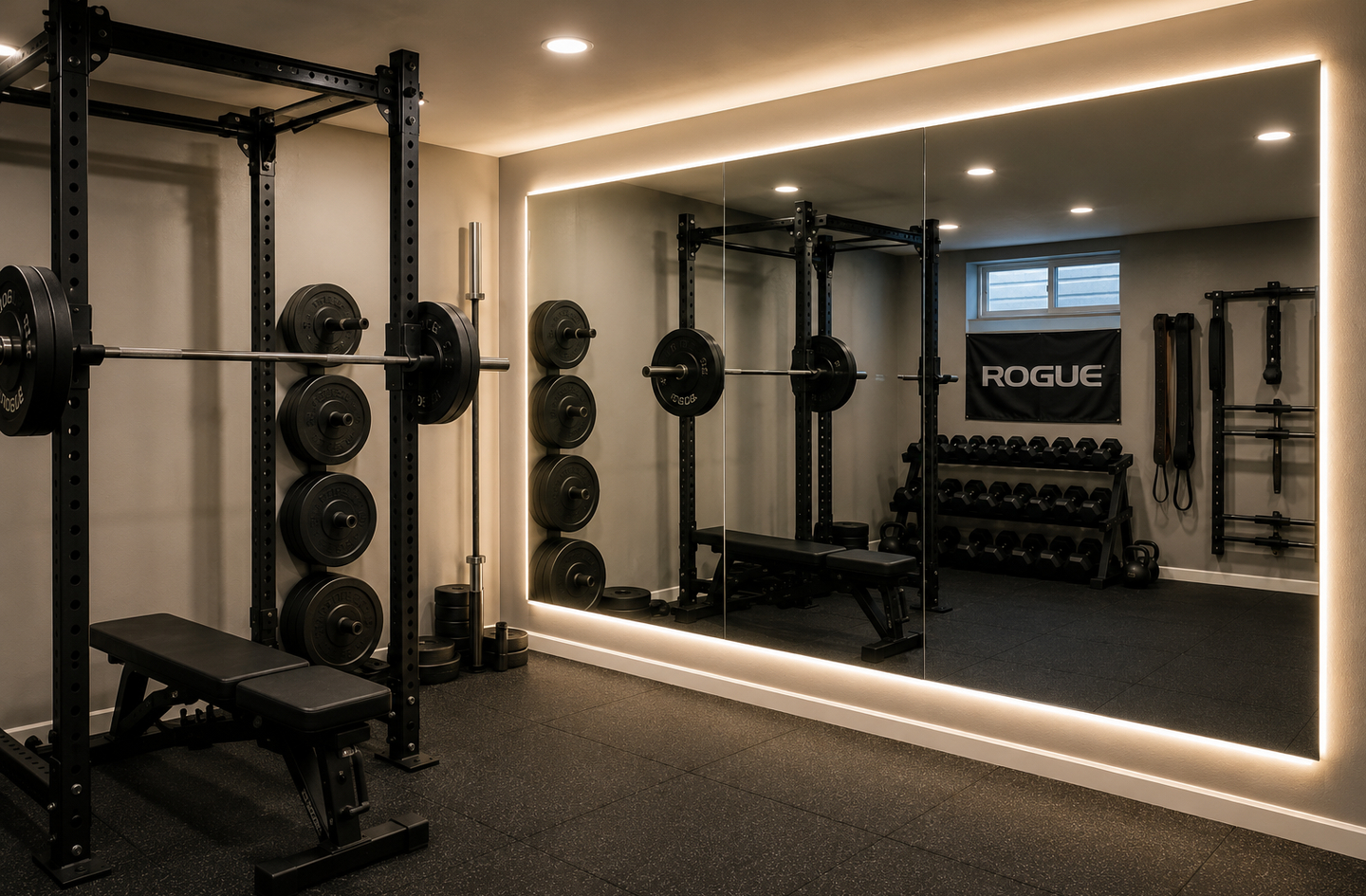
Home gym lighting and mirrors work as one system: the fixtures set what the lifter can see, and the mirror reflects only what that light reveals. The topic covers fixture output, fixture placement, light color, glare, mirror size and height, glass type, mounting, and care. It leaves out decorative accent lighting and room styling, except where they change visibility.
A foot-candle is a unit of illuminance equal to one lumen spread over one square foot. It measures the light that lands on a surface, which is what the eye and the camera actually use.
Correlated color temperature (CCT) is the color of a light source stated in kelvins, defined in federal rules by the blackbody temperature whose color most nearly matches the source2. Lower values look warm and amber, and higher values look cool and blue.
Color rendering index (CRI) is a measure of how much object colors shift under a light source compared with a reference source of comparable color temperature2. Poor color rendering flattens the contrast between skin, chalk, clothing, and knurling, so small position changes are harder to read.
Under the Consumer Product Safety Commission’s glazing rule, a mirror is a treated, polished, or smooth glazing material that forms images by reflecting light4. That places gym mirrors in the same family as other architectural glass, with the same breakage behavior and handling concerns.
Room surfaces shape both parts of the system. Dark rubber floors and painted block walls absorb light, so the same fixtures read dimmer than they would over pale surfaces. Garages add temperature swings and dust. Basements add low ceilings and beams that interrupt fixture spacing.
Why Lighting and Mirror Planning Matters
Lighting and mirror planning matters because a lifter who trains alone relies on the room for the feedback a coach would give. Poor light hides bar path, knee track, and squat depth. A mirror placed without a plan reflects fixtures straight back at the lifter.
The stakes are physical as well as visual. A national study counted more than 970,000 weight training-related injuries treated in U.S. hospital emergency departments between 1990 and 20075. In that study, free weights accounted for 90 percent of injuries, and weights dropping on a person caused 65 percent5. Free weights are the equipment that sits closest to a mirror wall, so glass type and placement belong in the safety plan, not the decor plan.
- Glare: a fixture reflected at eye level washes out the image during the exact rep the lifter is checking.
- Shadows: a single overhead fixture puts the lifter’s own body between the light and the bar path.
- Distortion: a flexible panel on an uneven wall bends the reflection, so a level bar can look tilted.
Understanding the system changes three outcomes: what gets bought first, where it gets mounted, and when a professional gets called. Light comes before mirrors, because a mirror adds nothing in a dark corner. New wiring, boxes, or circuits belong with a licensed electrician, and large or heavy glass belongs with a professional installer.
How Home Gym Lighting and Mirrors Work: The Six-Part Light-to-Glass Framework
The Light-to-Glass Framework splits the topic into six decisions, three about light and three about glass, ordered so each one sets up the next. It was derived by grouping every planning question in this cluster by the room constraint it answers.
Light Output and Fixture Types
Lumens are the total visible light a fixture emits, while foot-candles measure how much of it lands on the training surface. Total output starts from room area and a target level, then gets split across several fixtures so no single source has to be harsh. For scale, the federal definition of a general service incandescent lamp covers a lumen range of not less than 310 lumens and not more than 2,600 lumens2. A two-car garage gym needs several fixtures’ worth of output, not one brighter bulb. Fixture type decides how that output spreads. Recessed cans and track heads aim light, while linear and shop lights spread it along a strip. Hexagon grid lights cover a wide ceiling area but put a bright pattern in view during benching. Any new circuit, box, or hardwired fixture is a job for a licensed electrician.
Choose fixture count before fixture brightness, because several moderate sources light a lifter more evenly than one powerful lamp.
Deeper read: how many lumens a home gym needs.
Deeper read: LED fixture types for a home gym.
Deeper read: hex lights for a home gym.
Fixture Placement and Shadow Control
Fixture placement controls shadows more than fixture brightness does. A single fixture directly over the rack puts the lifter’s head and shoulders between the light and the bar, so the bar path falls into shade. Spreading fixtures around the rack, the bench, and the open floor fills those shadows from more than one direction. Ceiling fixtures also belong outside the sightline of a lifter lying on a bench. Garages add door tracks, open joists, and a parked car that limit where fixtures can go. Basements add beams and low ceilings, which favor low-profile fixtures spread across the room. Dark walls and floors absorb light, so the same layout feels dimmer in a room finished in black.
Plan fixtures from the lifter’s position under load, not from the center of the ceiling.
Deeper read: lighting placement that reduces shadows.
Deeper read: home gym lighting ideas for visibility.
Deeper read: garage gym lighting without bar-path shadows.
Deeper read: basement gym lighting for low ceilings.
Light Color, Glare, and Camera-Ready Light
Light quality decides whether the lifter can read what the light reveals. Color temperature sets the warm or cool look of the room, and color rendering sets how faithfully skin, chalk, and equipment colors appear. Glare is excess brightness in the field of view, such as a bare fixture or its reflection, that lowers contrast in everything around it. Glare is the main conflict between lights and mirrors, because a fixture reflected at eye level becomes a hot spot in the middle of the form check. Video adds its own problems. Some LED drivers flicker at rates a phone camera records as rolling bands, and a bright mirror in the frame makes the camera darken the lifter. A mirror gives live feedback from the front, while a phone gives replayable feedback from the side, where bar path and depth are easier to judge.
Set light color, fixture positions, the mirror, and the camera spot as one plan, because each one changes what the other three show.
Deeper read: color temperature and CRI for home gyms.
Deeper read: lighting for video form checks.
Deeper read: gym mirror lighting without glare.
Deeper read: mirror vs video for form checks.
Mirror Size, Height, and Coverage
Mirror size comes from the training position, not from the wall. For a standing view, the glass height needed depends on the viewer’s height, not on distance. The width the lifter can see grows with distance from the glass. Lifting adds range. A deep squat drops the eyes, and an overhead press raises the hands, so the bottom and top edges have to cover both ends of the movement. A lateral lunge or a wide-stance deadlift needs width as well. One full-length panel can cover a single standing station. A rack, bench, and open floor need a wider run of panels, with seams kept out of the main sightline.
Size the mirror for the lowest and highest positions of the lifts actually planned, then add width for the widest stance.
Deeper read: gym mirror wall planning.
Deeper read: home gym mirror size.
Deeper read: gym mirror mounting height.
Deeper read: full-length mirrors for home gyms.
Mirror Material, Thickness, and Safety Backing
Material decides reflection quality, weight, and how the mirror fails. Glass gives the clearest, flattest image but is heavy and breaks. Acrylic is lighter and resists shattering, but it scratches and flexes, so large sheets can read wavy. Thickness and wall flatness work together, because a thin panel on an uneven wall bends with the wall and distorts the image. Safety backing is a film bonded to the back of a mirror that holds fragments together if the glass breaks. It changes how breakage behaves, not whether glass breaks. Laminated glass, by contrast, is two or more pieces of glass bonded to a resilient plastic interlayer4. Small mirror tiles cost less and suit renters, but their seams and uneven planes break up the reflection. Custom cuts make sense when outlets, trim, or odd wall sizes rule out standard panels.
Treat no mirror as impact-proof: choose the material for the room, then keep the glass out of bar and plate paths.
Deeper read: acrylic vs glass gym mirrors.
Deeper read: mirror thickness and wall flatness.
Deeper read: safety-backed gym mirrors.
Deeper read: mirror tiles for a home gym.
Deeper read: custom gym mirrors.
Mirror Installation, Room Climate, Cost, and Care
Mounting starts with the wall. Drywall, studs, concrete block, and poured concrete each call for different channels, clips, or mirror-rated adhesive, and large or heavy glass calls for a professional installer. Garages add condensation, dust, and temperature swings that attack mirror edges and backing. The EPA advises keeping indoor humidity below 60 percent, ideally between 30 and 50 percent6. Edge damage starts where moisture sits against the silver coating. A realistic budget separates material, panel size, delivery, hardware, wall preparation, and installation, because glass price alone hides much of the cost. Cleaning should keep liquid off the edges: spray the cloth rather than the glass, and skip abrasive pads that scratch the surface.
Choose the mounting method from the wall type and room climate first, then let budget decide panel size and finish.
Deeper read: gym mirror installation by wall type.
Deeper read: garage gym mirrors for humidity and impact.
Deeper read: home gym mirror cost.
Deeper read: cleaning gym mirrors safely.
How to Choose Lighting and Mirrors for a Home Gym
The single most important criterion is the lifter’s position under load. Every fixture and mirror decision starts from where the eyes, the bar, and the camera sit during a working set.
- Mark each training station on the floor: rack, bench, open floor, and cardio.
- Place fixtures around those stations so light reaches the lifter from more than one direction.
- Choose one color temperature and a high color rendering rating for the whole room, so the mirror and the camera see consistent color.
- Size the mirror from the lowest and highest positions of the planned lifts.
- Pick glass, acrylic, or tiles for the room’s climate, impact risk, and budget.
- Confirm the wall type and mounting method, and call a licensed electrician or a professional installer for wiring changes or heavy glass.
Worked example, calculated from cited inputs. A 12 by 20 ft garage bay covers 240 square feet. Lighting it to the 30 foot-candles OSHA’s construction rule sets for offices takes 240 x 30 = 7,200 lumens on the floor1. Three lamps at the top of the federal general service incandescent range give 3 x 2,600 = 7,800 lumens2. Real rooms lose light to dark floors, dust, and fixture optics, so that result is a starting floor, not a finished design.
For the mirror, a plane mirror shows a standing viewer head to toe when its height is half the viewer’s height. For the average US man, that is 68.9 x 0.5 = 34.45 inches, or about 34.5 inches of glass3. A squat or an overhead press needs more, because the eyes drop and the hands rise.
The example shows why the order matters. Fixture output and spacing are fixed in the ceiling, while the mirror can only reflect what that output delivers to the lifter.

Common Lighting and Mirror Mistakes
Mistake 1: Buying the Mirror Before Fixing the Light
Why it is a mistake: A mirror reflects only the light that reaches the lifter, so a dim or one-sided room produces a dim, shadowed reflection.
What to do instead: Light the training stations first, then judge the mirror position under those fixtures.
Read more: home gym lighting ideas for visibility.
Mistake 2: Putting One Bright Fixture Straight Over the Bench
Why it is a mistake: A lifter lying on a bench looks straight up, so a fixture above the bench sits in the direct line of sight during every press.
What to do instead: Offset fixtures from the bench line and use diffused or linear fixtures that spread the light.
Read more: lighting placement that reduces shadows.
Mistake 3: Treating Safety Backing as Impact Protection
Why it is a mistake: Backing holds fragments together after a break, but it does not stop the break. In one national study, weights dropping on a person caused 65 percent of weight training injuries5. The same loose plates and bars can reach a mirror wall.
What to do instead: Keep the glass outside bar, plate, and kettlebell paths, and choose the material for the room’s impact risk.
Read more: safety-backed gym mirrors.
Mistake 4: Ignoring the Garage Climate
Why it is a mistake: Unconditioned garages swing in temperature and humidity, and moisture held against mirror edges damages the backing over time.
What to do instead: Control humidity, leave an air gap where the mounting system allows one, and pick hardware rated for the wall.
Read more: garage gym mirrors for humidity and impact.
Frequently Asked Questions
What color temperature is best for a home gym?
No single number fits every room, but neutral to cool white light keeps contrast high for lifting, while warmer light suits mobility areas. CRI matters too, because it measures how much object colors shift compared with a reference source2. Federal definitions class a fluorescent lamp as colored when its correlated color temperature is less than 2,500K or greater than 7,000K as determined according to IES LM-92. Use one color temperature throughout, so mirror and camera views match.
How bright should a home gym be?
A home gym should be bright enough to read bar path and joint position without glare. Lighting practice measures this in foot-candles, the light that lands on a surface. For comparison, OSHA’s construction rule sets 30 foot-candles for offices and 5 indoors in warehouses and corridors1. A lifting area belongs at the task end of that range. Spread the output across several fixtures, and judge brightness at the rack and bench rather than the room’s center.
Does a gym mirror need to be full height?
A standing full-body view needs glass about half the viewer’s height, so the average US man at 68.9 inches needs about 34.5 inches3. Lifting needs more than that. A deep squat drops the eyes and an overhead press raises the hands, so the bottom edge belongs near the floor and the top edge above the highest hand position. Panels that run close to both floor and ceiling suit full barbell work.
Are acrylic mirrors better than glass for a home gym?
Acrylic is lighter and resists shattering, which suits renters and walls that cannot carry heavy glass. Glass is flatter, clearer, and more scratch resistant, so it gives the more accurate reflection. Neither is impact-proof. Under the federal glazing rule, highly tempered glass breaks into small particles when fractured4. Pick the material from the wall, the room’s impact risk, and the distortion the lifter can accept, then keep it clear of bar and plate paths.
How This Guide Was Built
The methodology behind this guide is a desk review of federal regulations, a federal health agency page, an EPA guide, and a hospital research release. Each source links to the page that carries its figure. The six-part Light-to-Glass Framework was derived by grouping the cluster’s planning questions by the room constraint they answer. The worked example rests on the OSHA, DOE, and CDC figures listed in the References. Home Gym Specs editors hold editorial responsibility for this guide.
References
- Legal Information Institute, Cornell Law School – 29 CFR 1926.56, Illumination (OSHA construction standard, minimum illumination intensities in foot-candles)
- Legal Information Institute, Cornell Law School – 10 CFR 430.2, Definitions (U.S. Department of Energy consumer product energy conservation program)
- CDC National Center for Health Statistics – FastStats: Body Measurements
- Legal Information Institute, Cornell Law School – 16 CFR 1201.2, Definitions (Consumer Product Safety Commission safety standard for architectural glazing materials)
- Nationwide Children’s Hospital – New National Study Examines Weight Training-Related Injuries
- U.S. Environmental Protection Agency – A Brief Guide to Mold, Moisture and Your Home
Next Read
Light the lifter first, then size and mount the glass for the lifts the room will actually hold. Walls before racks, airflow before cardio gear, lighting before mirrors, clearance before the first heavy set.