Most home gym lighting ideas start with the fixture count, not the performance target those fixtures need to meet. The IESNA Lighting Handbook sets 20 to 30 foot-candles as the exercise-space baseline,1 a number most residential builds miss. This article covers how to layer ambient and task light around the rack, the floor, and the mirror, and explains why dark walls, overhead glare, and the wrong color temperature reduce visibility even when wattage looks adequate. See Home Gym Lighting and Mirrors for the broader planning overview connecting lighting with mirror placement and reflectance.
Quick Answer
What lighting setup actually prioritizes visibility in a home gym?
Target 20 to 30 foot-candles across the exercise floor using a layered system of ambient ceiling fixtures and zone-specific task lights.1 Use LED fixtures rated CRI 80 or higher and 4000K to 5000K for weight training zones.2 Wire in dimming from the start and add extra fixture output for dark rooms: a wall with a Light Reflectance Value of 5 absorbs roughly 95 percent of all incident light.8
Key Takeaways
- The IESNA Lighting Handbook targets 20 to 30 foot-candles for exercise and workout spaces; ANSI/IES RP-6-24 (2025) specifies 30 fc for recreational gyms and names 5000K as the de facto multi-sport standard.12
- Dark rubber flooring and dark painted walls absorb 80 to 95 percent of incident light, compounding each other and requiring substantially more fixture output than a white-walled space to hit the same target.8
- Color temperature governs alertness as much as lux level: at 40 lux, a 6500K cool-white source produced faster reaction times than a 3000K source at the same intensity in a peer-reviewed study.3
- Wire dimming circuits in before any fixture goes up; retrofitting dimming after the fact costs significantly more and requires new switch wiring.
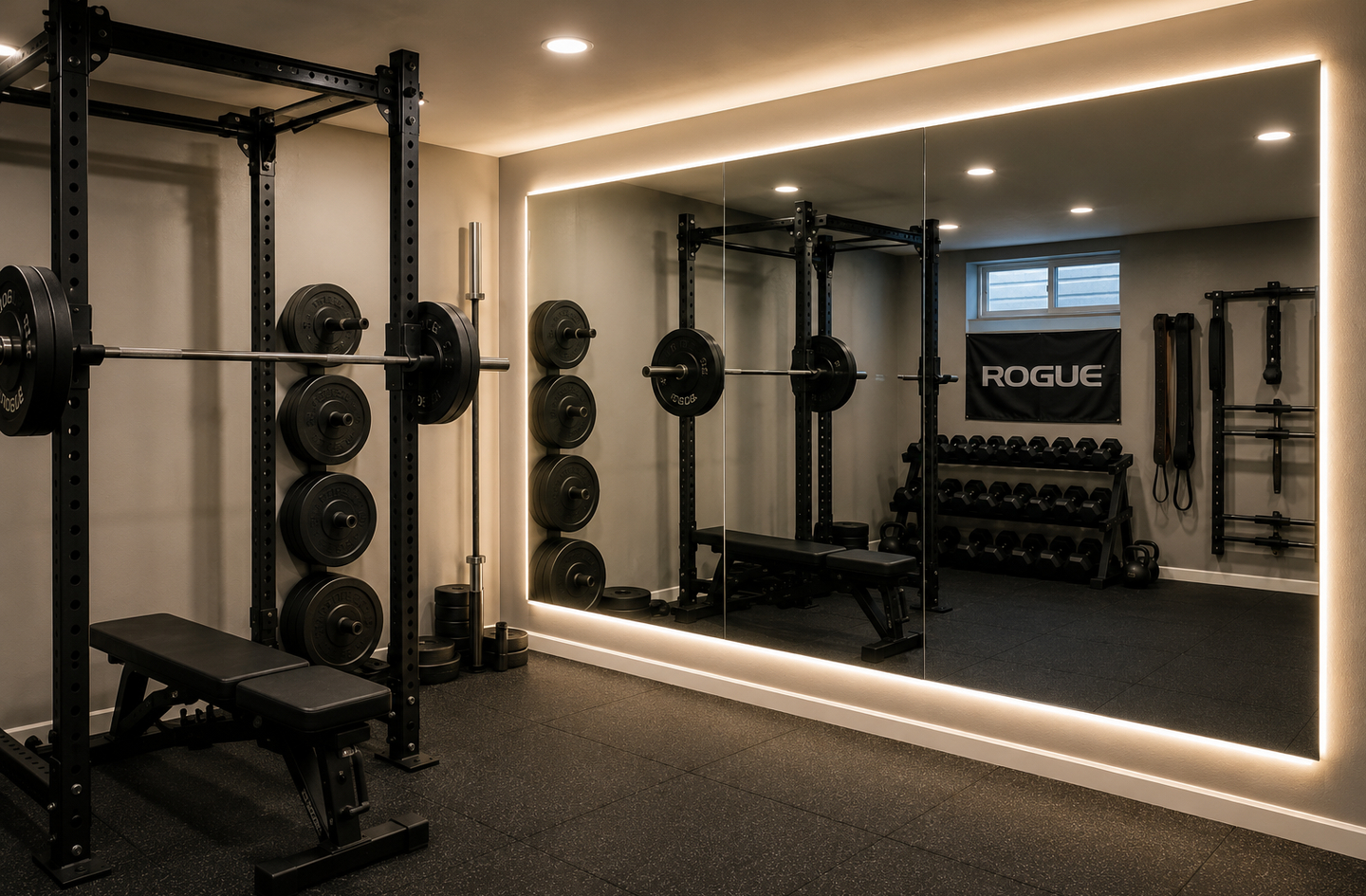
- Overhead fixtures placed in front of the mirror create glare on the reflective surface; mount them behind the training position to keep the mirror readable.
Before You Plan Home Gym Lighting Ideas: Read the Room First
Effective home gym lighting starts before any fixture is chosen. The room changes how much light a given set of fixtures actually delivers: ceiling height, surface color, and mirror placement all affect whether the light lands where it needs to.
Three key variables govern a well-lit training space. First, illuminance is the measure of how much light falls on a surface, expressed in foot-candles (fc) in the United States or lux in metric terms. Second, color temperature, measured in Kelvin, affects both alertness and movement perception under those lights. Third, uniformity ratio describes whether the light is spread evenly across the floor or clustered under fixtures with dim zones between them.
The common approach, one bright fixture mounted at the ceiling center, produces a room that is bright at the core and dim at the edges where most training happens. A squat rack along the wall, a deadlift platform in the corner, and a mirror on one side all sit outside the direct cone of a central ceiling light. Planning for those positions before any wire is run avoids the most common and most expensive rework in home gym builds.
Ceiling height also governs fixture selection. A standard 8-foot residential ceiling can accept a recessed can or a flush LED panel. A basement at 7 feet may be too shallow for the same can. A garage at 10 feet gives more flexibility on beam angle and fixture type but requires higher lumen output to maintain the same foot-candle reading at floor level, because light intensity falls off with distance from the source.
The Sequence That Prevents Costly Rework
Set zone targets before specifying fixtures. Plan the ambient ceiling grid before placing task lights. Confirm the dimming circuit before finalizing fixture selection. This sequence costs nothing extra at the planning stage and avoids the most common retrofit cost: cutting new wire paths after drywall and fixtures are already in place. Consult a licensed electrician for any new circuit work before the walls close.
Step 1: Set Your Target Illuminance by Zone
Different training zones in the same room need different light levels. A yoga corner used for stretching and recovery needs far less light than the squat rack. Sizing the whole room to the peak target wastes energy and can create glare in low-intensity areas.
The IESNA Lighting Handbook specifies 20 to 30 foot-candles for exercise and workout spaces and 30 to 50 fc for sports and games use.1 ANSI/IES RP-6-24 (2025), the current U.S. standard for sports and recreational lighting, sets 30 fc as the maintained horizontal illuminance for Class IV recreational gymnasiums and identifies 5000K as the de facto color temperature standard across multi-sport facilities.2
Color Rendering Index (CRI) is a scale from 0 to 100 that measures how accurately a light source renders colors compared to natural daylight. For a gym where you are reading depth cues in a mirror, judging bar height on a loaded lift, or monitoring skin color for fatigue signals, a CRI below 80 reduces the fidelity of visual information that affects safe and accurate training. The U.S. Department of Energy recommends a minimum CRI of 80 for indoor applications and considers CRI 90 and above excellent.7
The table below synthesizes IESNA and ANSI/IES RP-6-24 guidance into practical home gym zones. The mirror zone carries a higher CRI requirement and a stricter glare limit than the general training floor because the glass amplifies glare from any nearby point source.
| Zone | Target (fc) | CCT | CRI Minimum | UGR Limit |
|---|---|---|---|---|
| Recovery / Yoga | 5-10 | 2700-3000K | 80 | 25 |
| Cardio | 15-20 | 4000K | 80 | 22 |
| Weight Training | 20-30 | 4000-5000K | 80 | 22 |
| Sports / Games | 30-50 | 5000K | 80 | 22 |
| Mirror Zone | 30+ | 4000-5000K | 90 | <19 |
Sources: IESNA Lighting Handbook via Archtoolbox1 and ANSI/IES RP-6-24 (2025) via 1st Source Lighting.2
Unified Glare Rating (UGR) is a metric for the discomfort caused by bright sources in a person’s field of view, rated from under 10 (imperceptible) to above 28 (intolerable). The mirror zone carries UGR below 19 in the table rather than the standard 22 because the ANSI/IES standard was designed around a seated observer at a desk, not a lifter doing overhead press or pull-ups with eyes pointed at a bright fixture reflected in the glass.2 Once zone targets are mapped to a rough floor plan, the layout reveals whether separate circuits are needed for each zone and how many switch locations to rough in.
Step 2: Plan the Ambient Layer First
The ambient layer provides baseline illumination across the entire floor. It does not need to meet the peak training target by itself; it is the foundation on which task lighting builds. For most home gyms, the ambient layer is a grid of LED ceiling fixtures spaced to maintain a uniformity ratio of at least 0.7, meaning the minimum illuminance reading across the floor is no lower than 70 percent of the average.2 Below that threshold, the dark zones between fixtures become visible and distracting during movement.
Fixture Type by Ceiling Height
At 8 feet, LED flat panels (1×4 or 2×4 foot format) mounted flush spread light across a wider cone than a recessed can and avoid the dark ring a narrow-beam downlight creates around each fixture. At 10 feet or higher, high-bay pendants or wide-beam flush-mounts with 120-degree or broader beam angles maintain better floor coverage. Recessed cans with flood-beam bulbs work in standard ceilings but require tighter spacing than most residential construction provides. A single 4-inch can at the center of a 12×12-foot gym is almost never adequate on its own.
LED Efficiency and Output Selection
Modern LED fixtures deliver 130 to 150 lumens per watt compared to 50 to 100 lm/W for T8 fluorescent tubes,7 and use up to 44 percent less energy at the same output level.7 For a training space where mirror feedback informs movement correction, choosing CRI 90 or above in the mirror zone adds meaningful color fidelity over a standard CRI 80 fixture at a modest cost premium. Do not accept a fixture labeled “daylight” without confirming both the CCT and the CRI; the two are independent, and a 5000K fixture can have a CRI as low as 70.
Step 3: Add Task Lighting Around the Rack and Training Floor
Ambient lighting covers the floor but does not address the vertical planes where training happens. The squat rack creates a shadow below the bar at exactly the height where a lifter needs to see the plates, the J-cups, and the safeties. A barbell on the floor for a deadlift sits close to the ground, and pure overhead light flattens the depth cues that separate the bar from the mid-foot position.
Task lighting fills those shadows with directional light from a different angle than the ceiling fixtures. The goal is not to replace the ambient layer but to add side-angle illumination that creates dimension in the vertical plane of the rack and separation between the bar and the platform.
Rack Zone Placement
For the rack, mount task lighting on the wall or ceiling behind the training position, angled downward toward the front of the rack. A single adjustable track head in the 1,000 to 1,500 lumen range is usually sufficient as a supplement to the ambient layer. Side-angle light separates the bar from the J-cup and makes safety height easier to judge during a loaded set. Avoid placing any task light between the lifter and the mirror; a point source at roughly eye height will reflect in the glass and reduce mirror clarity when form feedback matters most.
Floor and Platform Zone
For a deadlift platform or floor-based training area, low-angle light from the side reveals surface texture and clarifies foot position relative to the bar. A wall-mounted LED strip or a track fixture at roughly waist height, aimed across the platform, accomplishes this without additional circuits. The mirror wall often backs the deadlift zone; for help planning that wall independently, see gym mirror wall planning for panel size, coverage area, and sightline guidance.
Step 4: Position Lights to Serve the Mirror, Not Wash It Out
A mirror in a home gym serves two purposes: movement feedback during a set and form analysis from the side or from a recorded angle. Both fail when a bright overhead fixture creates a washed-out reflection that overpowers the image of the lifter.
The problem is geometry. A ceiling fixture between the training position and the mirror reflects back at roughly eye height. The angle of incidence equals the angle of reflection: a fixture close to the mirror’s surface produces a reflection that travels forward into the lifter’s eyes. Keep primary ceiling fixtures behind the training position, not in front of it, and confirm the angle from the mirror surface to the eye position clears 30 degrees for all primary fixtures.
UGR Targets for Overhead and Mirror Work
ANSI/IES RP-6-24 specifies UGR below 22 for recreational facilities but was designed around a stationary seated observer, not a lifter looking upward during overhead press, pull-ups, or snatches.2 A protective target for the mirror zone in a home gym is UGR below 19 in the overhead field of view. This is achievable with correct fixture placement: LED flat panels mounted well behind the training position typically reach UGR below 19 at the mirror plane without any additional hardware or special fixtures.
Mirror-Perimeter LED Strips
LED strips around the mirror perimeter produce a softer, diffuse light that avoids the point-source glare of a ceiling fixture and raises ambient brightness at face height. A strip rated 3000K to 4000K, dimmed to around 30 percent of its maximum, works better as a supplement than as a primary source. At full brightness, a perimeter strip can create its own reflected band along the mirror edge. For mirror installation specifics across drywall, block, and concrete substrates, see gym mirror installation plans for substrate-matched mounting methods.
Step 5: Account for Wall Color and Floor Reflectance
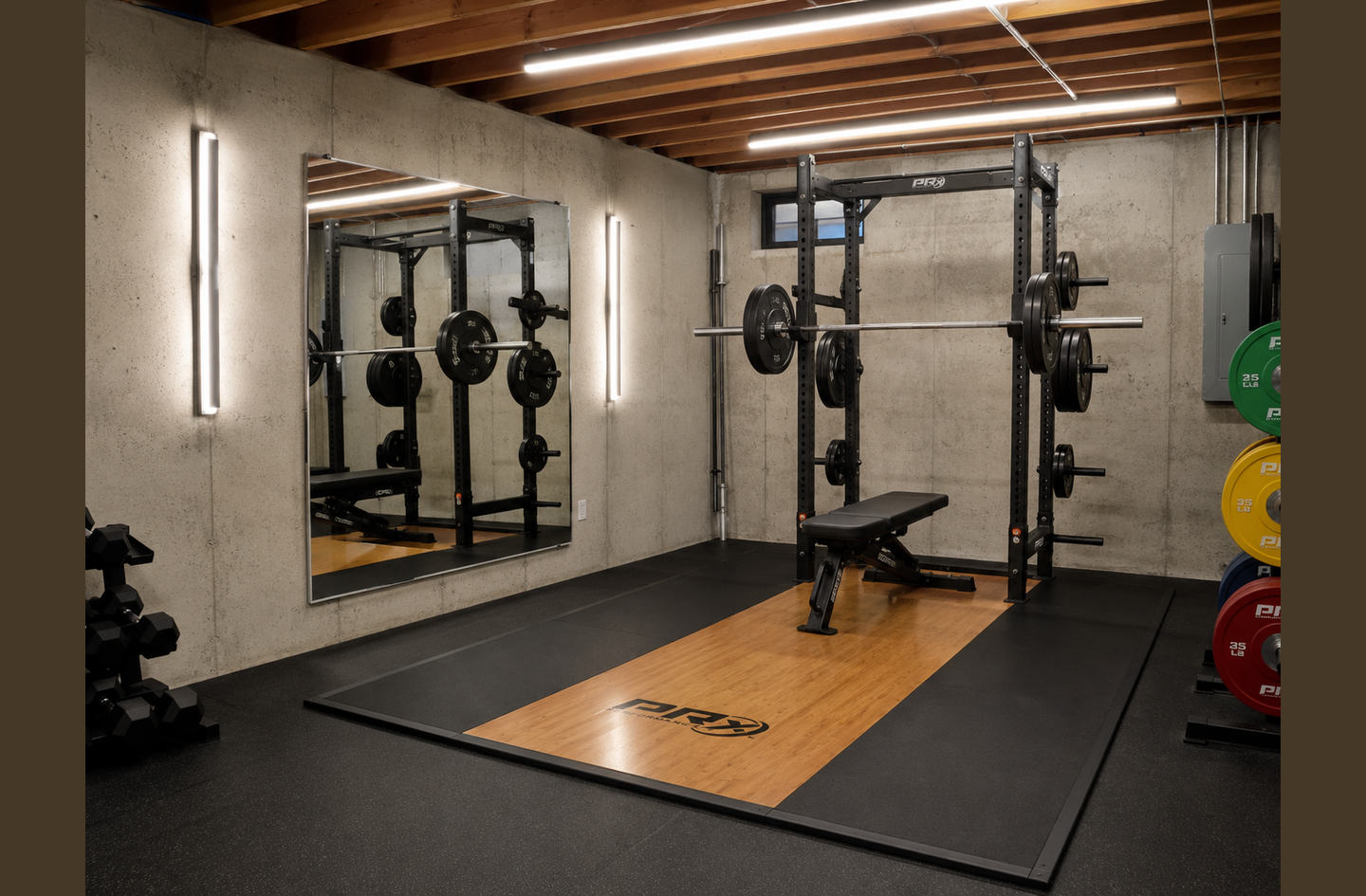
The IESNA foot-candle targets in Step 1 assume reasonably reflective room surfaces. A white-walled room makes efficient use of every lumen the fixtures produce: light bounces from ceiling to wall to floor and continues contributing to the ambient level across the whole room. A room with dark walls and black rubber flooring is a fundamentally different calculation.
A wall painted in deep charcoal or black has a Light Reflectance Value (LRV) near 5, meaning it absorbs roughly 95 percent of incident light.8 LRV is a scale from 0 (absorbs all light) to 100 (reflects all light); the percent absorbed by any surface is simply 100 minus the LRV. A white wall at LRV 90 absorbs only 10 percent of the light that reaches it. Black rubber flooring falls in the same LRV 5 to 10 range.8 When both surfaces are dark, the only light reaching the training floor is the direct downward component from the fixtures, with almost no contribution from surface inter-reflection.
The practical implication: add 50 to 100 percent more lumens to the fixture plan for a dark-themed gym. Distribute that additional output across more fixtures in the grid rather than increasing wattage on a single unit, to maintain uniformity.
Using LRV in a Fixture Count
Most paint brands publish LRV on their product data sheets or provide it on request. Black stall mats and rolled rubber flooring can be assumed at LRV 5. White or light-gray floor paint (epoxy or polyurea coating) typically runs LRV 30 to 50, which meaningfully increases the floor’s light contribution compared to black rubber. This is not a reason to change the flooring for lighting’s sake; it is a reason to account for the actual flooring material before finalizing the fixture count and spacing grid. A room with LRV 5 walls and LRV 5 flooring requires roughly twice the fixture output of a room with LRV 80 walls and a light floor to reach the same target illuminance.8
Step 6: Choose Color Temperature for Your Training Time
Color temperature, measured in Kelvin (K), describes the spectral content of a light source: cooler sources at 4000K to 6500K produce blue-shifted light; warmer sources at 2700K to 3000K produce red-shifted light. ANSI/IES RP-6-24 identifies 5000K as the de facto standard for multi-sport gymnasium use, citing both alertness and color accuracy benefits.2 The research behind that preference is specific:
“The sensitivity of the human alerting and cognitive response to polychromatic light at levels as low as 40 lux, is blue-shifted relative to the three-cone visual photopic system.”
Sarah L. Chellappa and Christian Cajochen, University of Basel Centre for Chronobiology3
That finding has a direct planning implication: even dim cool-white light activates alerting pathways. A 6500K source at 40 lux produced faster sustained-attention reaction times than a 3000K source at the same intensity.3 A 2025 study published in the Journal of Exercise Science and Fitness found that blue-enriched light at 201 lux improved simple reaction time by 53.33 milliseconds compared to a control condition (p < 0.001).4 For morning or afternoon training, 4000K to 5000K in the main training zones is well supported by published evidence.
Evening Training and Spectral Shift
Harvard Medical School and Brigham and Women’s Hospital researchers found that blue-depleted LED at 50 lux produced only 24.6 percent melatonin suppression, compared to 56.5 percent from standard broadband fluorescent at the same intensity.5 That is a reduction of more than 50 percent in circadian disruption from spectral tuning alone, with no change in lux level.5 Dimming a 5000K fixture to half output still delivers 5000K light; the spectral distribution does not change with intensity. For evening gym users, a tunable or warm-dim LED system that shifts color temperature to 2700K to 3000K in the final hour of training reduces that circadian signal without sacrificing the brightness needed for safe training. This is a fixture specification decision, not a wall-switch decision, and it is made when the fixtures are selected, not after they are installed.
Step 7: Wire In Dimming Before the Fixtures Go Up
Dimming must be decided at the rough-in stage. Running a dimmer-compatible circuit and placing the switch box before drywall is a small fraction of the cost of cutting new wiring paths after fixtures are mounted. The decision also governs fixture selection: not all LED fixtures are dimmable, and not all dimmers are compatible with all LED drivers. A leading-edge dimmer specified for incandescent bulbs will not work correctly with most LED fixtures and will cause flickering or buzzing.
“There was a more than five-fold variation in nocturnal melatonin suppression between different LED light sources at the same lux intensity.”
Moore-Ede et al., Frontiers in Photonics, 2023 (248 co-signing researchers)6
That five-fold variation comes from the spectral content of the fixture, not the dimmer setting. The dimmer controls intensity; the fixture specification controls the spectrum. Both matter for a gym used in the evening, and both are determined before any fixture is installed. Specify LED fixtures with trailing-edge or universal dimmers and confirm compatibility with the fixture manufacturer before purchasing.
Scene Presets by Training Phase
If a smart dimmer or scene controller is in the budget, three presets cover most scenarios: full output at 5000K for a high-intensity session, mid-output at 4000K for moderate cardio or skill work, and low output at 2700K to 3000K for warmup or evening recovery work. A warm-dim LED fixture accomplishes similar results at lower cost, shifting from approximately 3000K at full brightness down to 1800K at minimum, reducing blue content as intensity decreases. These preset decisions affect rough-in switch count; confirm the wiring plan with a licensed electrician before the walls close.
Lighting Mistakes That Reduce Visibility Without Reducing Wattage
The following mistakes produce dim, uneven, or glare-heavy training spaces even when the wattage on the spec sheet looks sufficient on paper.
One Central Fixture
A single bright ceiling fixture illuminates the center of the room well and leaves the perimeter, where most equipment lives, in relative shadow. The uniformity ratio drops well below 0.7 and the contrast between the bright center and the dim edges becomes distracting during movement. Plan a grid of fixtures at consistent spacing rather than a single central point source.
Warm White in the Training Zone
A 2700K source reduces alertness in a training space by a measurable amount even at the same lux level as a 4000K source, because the alerting response to light is blue-shifted.3 Reserve 2700K to 3000K for recovery corners and cool-down spaces; use 4000K to 5000K wherever hard training takes place.
Ignoring Surface Absorption
Ordering fixtures based on a white-walled room specification, then installing them in a dark-walled gym with black rubber flooring, produces a room that may be 40 to 60 percent dimmer than expected. Check the LRV of walls and floor before finalizing the fixture count and output level.8
Fixtures in Front of the Mirror
Any fixture placed between the training position and the mirror creates a reflected point source at roughly eye height in the glass. The glare makes the mirror unreadable during heavy compound lifts, when form feedback matters most. Move ceiling fixtures to the rear of the training position or use side-mounted task lighting instead, keeping the mirror zone clear of direct overhead sources.
No Dimming Circuit
A room that runs only at full output cannot be adapted to different training conditions or times of day. A dimmer circuit costs very little at rough-in and is expensive to retrofit. Plan it in before any fixture is specified. For garage gym environments where wiring runs through an unconditioned space, see garage gym mirror planning for guidance on surface conditions that affect fixture and hardware selection in that environment.
Frequently Asked Questions
How many lumens do I need for a home gym?
For a standard 12×12-foot weight training zone targeting 25 foot-candles (the IESNA midpoint for exercise spaces),1 you need roughly 4,200 to 4,800 lumens of delivered light at floor level. With typical LED flat panels losing around 20 percent through the fixture housing and surface absorption, a reasonable starting figure is 5,500 to 6,500 total fixture lumens for that zone. Adjust upward by 50 to 100 percent if walls and floor are dark (LRV below 20).8
What color temperature is best for a home gym?
For daytime or afternoon training, 4000K to 5000K produces the best alertness and color accuracy; ANSI/IES RP-6-24 names 5000K as the de facto multi-sport gymnasium standard.2 For evening sessions ending within two hours of bedtime, shifting to 2700K to 3000K in the final hour reduces melatonin suppression by more than 50 percent compared to keeping a 5000K source at the same dimmed lux level.5
Why does my home gym feel dim even with bright bulbs?
The most common cause is dark surfaces absorbing most of the light before it reaches the training floor. A wall with LRV 5 absorbs roughly 95 percent of incident light,8 and black rubber flooring does the same. The second cause is poor uniformity: a single bright central fixture produces high readings directly below it and dim readings at the perimeter. A grid of fixtures at consistent spacing maintains a uniformity ratio of 0.7 or higher across the full floor.2
How should I light a home gym mirror to avoid glare?
Mount primary ceiling fixtures behind the training position rather than between it and the mirror. Keep the angle from the mirror surface to the eye position greater than 30 degrees for all primary fixtures. For the mirror zone specifically, target a UGR below 19 rather than the standard 22,2 since overhead gym movements bring the eyes into a wider field of view than a standard seated observer, amplifying perceived glare from reflected sources.
Do I need a separate lighting circuit for a home gym?
A separate lighting circuit is not required by most residential codes, but it is worth running if you are adding dimming, smart controls, or a large fixture load in a new or renovated space. A dedicated circuit prevents the gym lighting from sharing a breaker with cardio equipment, which can cause flickering on dimmable LEDs under varying loads. Consult a licensed electrician to confirm circuit requirements for your specific fixture load and local electrical code before roughing in any wiring.
Limitations and Edge Cases
- The foot-candle targets and color temperature guidance here apply to a standard single-purpose home gym. A gym that also functions as a living room or guest room needs a wider CCT range and separate zone control to avoid the alerting effects of high-CCT light during non-training use.
- All lux and foot-candle figures reference maintained illuminance at floor level. Initial fixture output is higher and degrades over time; check the L70 rating of fixtures (the point at which output drops to 70 percent of initial) when planning long-term targets.
- The LRV discussion uses a simplified direct-absorption model. Real inter-reflectance depends on room geometry, ceiling height, and surface proportions. Professional photometric software gives more precise results for large or unusual spaces.
References
Methodology: every figure below comes from an independent published source and links directly to the page carrying it; no competitor domains are cited. This article is reviewed against current IES and peer-reviewed lighting research on a recurring basis.
- Archtoolbox – Recommended Lighting Levels in Buildings, citing IESNA Lighting Handbook. Updated March 7, 2021.
- 1st Source Lighting – Gymnasium Lighting Standards Explained, citing ANSI/IES RP-6-24 (2025). April 30, 2026.
- PLoS ONE – Chellappa SL, Steiner R, Blattner P, Oelhafen P, Gotz T, Cajochen C. Non-Visual Effects of Light on Melatonin, Alertness and Cognitive Performance: Can Blue-Enriched Light Keep Us Alert? PLoS ONE 6(1): e16429. January 26, 2011.
- PMC / Journal of Exercise Science and Fitness – Sirayder O, Orunoglu M, Yilmaz AK. Acute effects of blue and red light on cognitive performance and exercise capacity in healthy adults. JESF 23(4): 415-424. August 13, 2025.
- PMC / Physiology & Behavior – Rahman SA, St Hilaire MA, Lockley SW. The effects of spectral tuning of evening ambient light on melatonin suppression, alertness and sleep. Physiology & Behavior. 2017.
- Frontiers in Photonics – Moore-Ede M, Blask D, Cain S, Heitmann A, Nelson R et al. Lights should support circadian rhythms: evidence-based scientific consensus. Frontiers in Photonics 4. October 4, 2023. DOI: 10.3389/fphot.2023.1272934.
- U.S. Department of Energy – LED Basics: Solid-State Lighting. Office of Energy Efficiency and Renewable Energy. Ongoing resource page.
- CE Center / Architectural Record – The Science of Visible Light and Its Impact on Paint Specification. Authored by Juliet Grable. June 2020.
Conclusion
Visibility in a home gym is the product of the right illuminance level, a layout that maintains uniformity across all training zones, fixtures positioned to avoid reflected glare in the mirror, and a color temperature that matches when and how the space is used. Dark surfaces compound every shortfall: each lumen absorbed by a black wall or rubber floor is a lumen that never reaches the training floor.
The steps in this guide build in a specific order: set zone targets, plan the ambient grid, add task lighting for rack and floor, position fixtures relative to the mirror, account for surface reflectance, specify color temperature for the training time, and wire in dimming before any fixture goes up. Getting that sequence right avoids the rework that follows when fixtures are chosen before the room is understood. See Home Gym Lighting and Mirrors for how this sequence fits with mirror placement, room layout, and the rest of the room-readiness planning.