A rack goes in before anyone measures how far back the lifter can stand. The mirror then gets bought by the sheet, not by the lift. The right home gym mirror size is a geometry problem first and a shopping problem second. It fits inside the broader planning overview in Home Gym Lighting and Mirrors. The right size tracks three things: the distance between lifter and wall, the vertical range of the lifts planned, and the horizontal spread of a loaded stance. The average US adult male stands 68.9 inches tall1, enough to break the standard 72 inch gym panel on an overhead press lockout.
Quick Answer
What size mirror does a home gym actually need?
A home gym mirror needs to be tall enough to catch the full standing height plus any overhead reach, and wide enough to catch the loaded stance. For an average US adult that is at least 72 inches tall and 48 inches wide at the panel2, mounted 12 to 18 inches above the floor3, with the lifting position 6 to 8 feet off the glass.
Key Takeaways
- The home gym mirror size is set by the lift, not by the wall: measure the lifter to wall distance first, then the vertical and horizontal range of the lifts planned.
- A standard 48 by 72 inch gym panel in 1/4 inch tempered glass with a safety backing weighs about 78 pounds4, which decides anchor points and whether two people are needed to install it.
- A single large panel removes seams from the sightline, several smaller panels fit through doors and route around light fixtures and outlets; usable coverage, not panel count, is the metric that matters.
- Any gym panel over 9 square feet sits in a hazardous-location category and is expected to be Category II safety glazing (ANSI Z97.1 Class A, 400 ft-lb impact)5, which is why “hardware store mirrors” are the wrong product.
- Mounting height is 12 to 18 inches off the floor for strength work and flush at the floor for yoga and ground-based movement3, which decides panel height long before width does.
Prerequisites: Measure the Room, Then Choose a Home Gym Mirror Size
A gym mirror sized to the wall tends to be the wrong mirror. Home gym mirror size is a function of the lifter’s position and the lifts planned, not the length of the wall. The room check comes first: the mirror follows from it.
Before any panel gets ordered, four room facts need to be on paper. Measure the floor to ceiling height at the mirror wall, including any beam or duct that drops below the main ceiling. Measure the floor to lowest overhead obstruction. Measure the clear distance from the lifting position to the mirror wall. Note the wall type at the mounting height: drywall over wood studs, drywall over steel studs, poured concrete, concrete block, or brick. Mounting approaches differ for each, and the sibling guide mounting approaches for drywall, studs, block, and concrete walks through them.
A sightline is the uninterrupted line of view between the lifter’s position and the reflected image during a lift. Any item that sits inside that line, a hanging light, a bar in the J-cup, a wall-mounted plate rack, a shelving unit, decides where the panel can go before the panel size is picked. Room first, panel second.
The final prerequisite is light. A mirror with a bright window directly opposite it will glare back in the lifter’s eyes at the setup for every lift. For the room-side half of that pairing, the sibling guide on lighting that prioritizes visibility over vibe covers how fixtures and the mirror interact.
A mirror in the wrong place is worse than no mirror: the lifter trusts a reflection that misleads on bar path and depth, which is why the room check runs before the shopping check.
Step 1: Set the Lifter to Wall Distance
The useful mirror width shrinks fast when the lifter stands too close to the glass. For a standing form check on squats, deadlifts, lunges, and standing presses, the lifter needs to be 6 to 8 feet back from the panel to see the full body in the reflection7. Any closer, and the panel has to grow to catch the loaded stance.
Measure the clear distance from the rack footprint to the mirror wall, then subtract the typical bar-out and bail-out depth. A squat rack planted 3 feet from the mirror wall leaves roughly 1 foot of walking path between the lifter at setup and the glass, which is not enough space for the mirror to catch anything useful. For context on racking distance and clearance behind the lifter, the sibling guide on mirror wall planning, panel size, and sightlines covers the full set of distances.
In a small room, the choice is often binary: move the rack farther from the mirror wall, or accept that the mirror only catches a partial view at setup and nothing on bail-out. Both are legitimate choices as long as the trade-off is explicit before the panel is ordered.
Ceiling height caps the usable viewing distance from above. A low basement with a 7 foot ceiling cannot carry an 84 inch panel at 12 inches off the floor, so the panel has to shrink even when the room is deep. For the room-type half of that constraint, the hub overview covers basement and garage-specific limits.
Viewing distance decides whether a 48 by 72 panel reads as “big enough” or “cramped”: the same panel at 8 feet back feels generous and at 3 feet back feels useless, and the panel does not change.
Step 2: Set the Minimum Panel Height for the Lifts Planned
Panel height is set by the tallest point the lifter needs to see in the reflection, plus the lowest. For a standing form check only, a 72 inch panel at 12 to 18 inch mounting height covers an average US adult from feet to just above the crown. The CDC’s measured average for adult men is 68.9 inches, for adult women 63.5 inches1, so a 72 inch panel leaves a few inches of margin for a tall lifter but no reach-up margin.
Overhead work breaks the standard panel height. At lockout on a strict overhead press, the lifter’s extended fist sits roughly 20 to 24 inches above the crown of the head, which is above 90 inches off the floor for an average male lifter. A single 72 inch panel at a 12 inch mount reaches 84 inches, so the overhead lockout is cut off at the fingertips.
Three honest options exist for overhead work. The first is a taller panel: 84 or 96 inches, cut to order, and placed where the ceiling allows. The second is two panels stacked, which puts a seam across the chest and loses the lockout to the seam. The third is to defer the overhead view to a side-angle camera and let the mirror catch the standing and squat positions only. Each is a trade-off between glass area, cost, and sightline integrity.
Squat depth sets the lower end. For a competition-legal squat the hip crease must descend below the top of the knee6, which puts the hips roughly 20 to 24 inches off the floor at the bottom position for most adult lifters. A panel mounted at 18 inches off the floor cannot show the bar on the floor at a deadlift setup, so a deadlift-primary setup wants a lower mounting height or a floor-flush panel.
Panel height is not one answer; it is the max of three answers (standing form, overhead reach, floor-level setup), and the lifter decides which to sacrifice when the ceiling will not carry all three.
Step 3: Set the Minimum Panel Width for a Loaded Stance
Panel width is set by the widest horizontal footprint the lifter will take under load. A standing form check for a bodyweight exercise fits inside a 36 inch width for most adults. A loaded barbell squat or press widens that: the plates on the bar extend beyond the shoulders, and a sumo deadlift stance widens the foot position well past shoulder width.
For a single-lifter home gym, 48 inches of panel width is the practical floor for seeing the full loaded stance plus the plate ends. Industry convention lands here: the standard commercial gym panel is 48 inches wide by 72 inches tall in 1/4 inch glass with a safety backing2. The width came from catching the loaded stance, not from catching the wall.
Lateral movement widens the width requirement further. A walking lunge, a lateral band step, or a dumbbell farmer carry can cross a 6 foot lateral distance. The lifter either faces the mirror and steps across it, which calls for a 72 inch or wider panel, or accepts that lateral work is coached by feel rather than by reflection.
Two lifters sharing a mirror doubles the width requirement at the point where they would both be in frame. In a shared garage gym where a partner spots a squat, a 72 inch panel catches the lifter under the bar but cuts the spotter out of the frame; a 96 inch combined width captures both. Where that matters, two panels placed side by side are the cheaper answer; where it does not, 48 inches is enough.
Width is a stance problem, not a wall problem; the right question is “what is the widest foot position I will take under load this year” and the answer is almost always wider than the lifter first guesses.
Step 4: One Large Panel or Several Smaller Panels
Panel count is a sightline problem, not a wall-length problem. A single large panel removes seams from the sightline, which is the main argument for one piece. Nothing cuts across the bar path at the lockout, nothing crosses the lifter’s eye line at the setup, and nothing interrupts the lifter’s read of shoulder level during an overhead press.
Several smaller panels have real advantages a single-pane install cannot match. A single 48 by 96 inch panel in 1/4 inch tempered glass weighs roughly 105 pounds on its own4, and the finished install needs two installers to move it without flex damage. Three 24 by 72 inch panels can be carried individually, routed around light fixtures and outlets, and replaced one at a time when one gets chipped.
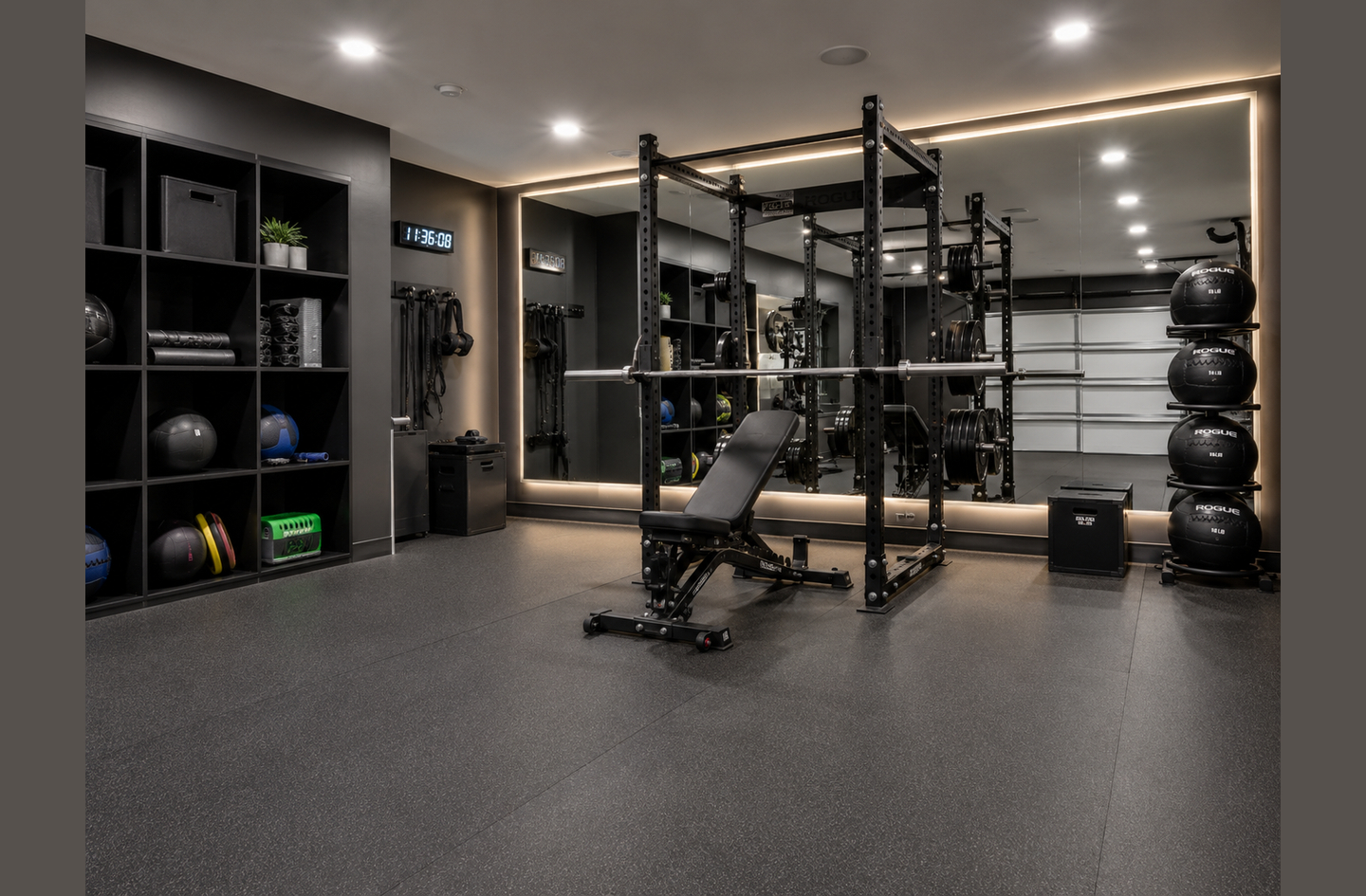
Panel count also matters for budget phasing. A room-ready mirror install can start with one 48 by 72 panel at the primary lifting position and add a second panel for a dedicated accessory zone a year later. The sibling guide on mirror wall planning, panel size, and sightlines works through the staged install logic.
The usable-coverage test decides the question. Draw the sightline from the lifting position to each panel edge, and count how many lifts are read cleanly. One large panel wins when the primary lift is overhead work or an upright bar press. Several panels win in three cases: standing form checks across a wider lateral range, a wall that carries outlets, switches, or HVAC returns that would force a seam anyway, and an install path that must clear a doorway or stair landing.
Seam placement, when panels are used, is non-negotiable. The seam cannot cross the lifter’s eye line at setup, the bar line at the top of the lift, or the hip line at a loaded carry. A seam between the eye level and the top of the head is visually tolerable; a seam across the chest at an overhead lockout turns a form-check tool into a distraction.
Usable coverage, not glass square footage, is the number that matters, and a 48 by 72 single panel with its seam-free sightline often beats a wall-to-wall multi-panel install that happens to break at the lifter’s eye line.
Step 5: Pick the Glass Class, Thickness, and Backing
Safety backing is a thin adhesive film laminated onto the back of a mirror that holds broken pieces together on impact. For any mirror within range of a dropped plate, a swung bar, or a kettlebell, the safety backing is the difference between a crack that stays in place and shards on the floor. Industry convention for commercial gym mirrors is 1/4 inch glass with a safety backing8, and bathroom mirrors at 1/8 inch thickness without backing are not the same product.
Category II safety glazing is a US regulatory class for architectural glass panels larger than 9 square feet, tested to withstand a 400 ft-lb impact without producing hazardous shards5. A 48 by 72 inch panel is 24 square feet, well past that threshold. The relevant impact test for the industry is ANSI Z97.1 Class A, equivalent to the Category II requirement under 16 CFR 1201.
“The lifter must bend the knees and lower the body until the top surface of the legs at the hip joint is lower than the top of the knees.”
International Powerlifting Federation, Technical Rules Book, squat depth definition6
Weight follows thickness. A 1/4 inch mirror weighs roughly 3.27 pounds per square foot4, so a 48 by 72 panel is about 78 pounds, and a 48 by 96 panel is about 105 pounds. That number decides whether the install is a one-person or two-person job and what anchor density the wall needs. The wall-type question, covered in the sibling guide on mounting approaches for drywall, studs, block, and concrete, cannot be answered until the panel weight is known.
Climate decides whether the chosen glass survives. A garage with condensation on cold mornings or a basement with summer humidity will attack a cheap backing within a season. The sibling guide on garage mirrors and humidity, temperature, and impact covers the backing and placement questions for unconditioned spaces, which is where most home gyms actually live.
The right home gym mirror size at the wrong thickness is a different mirror in six months: 1/4 inch tempered with a safety backing is the floor for anything in impact range, and the lower-thickness, lower-cost options read as savings until the first plate rolls into them.
What Success Looks Like: A Mirror That Catches the Whole Lift
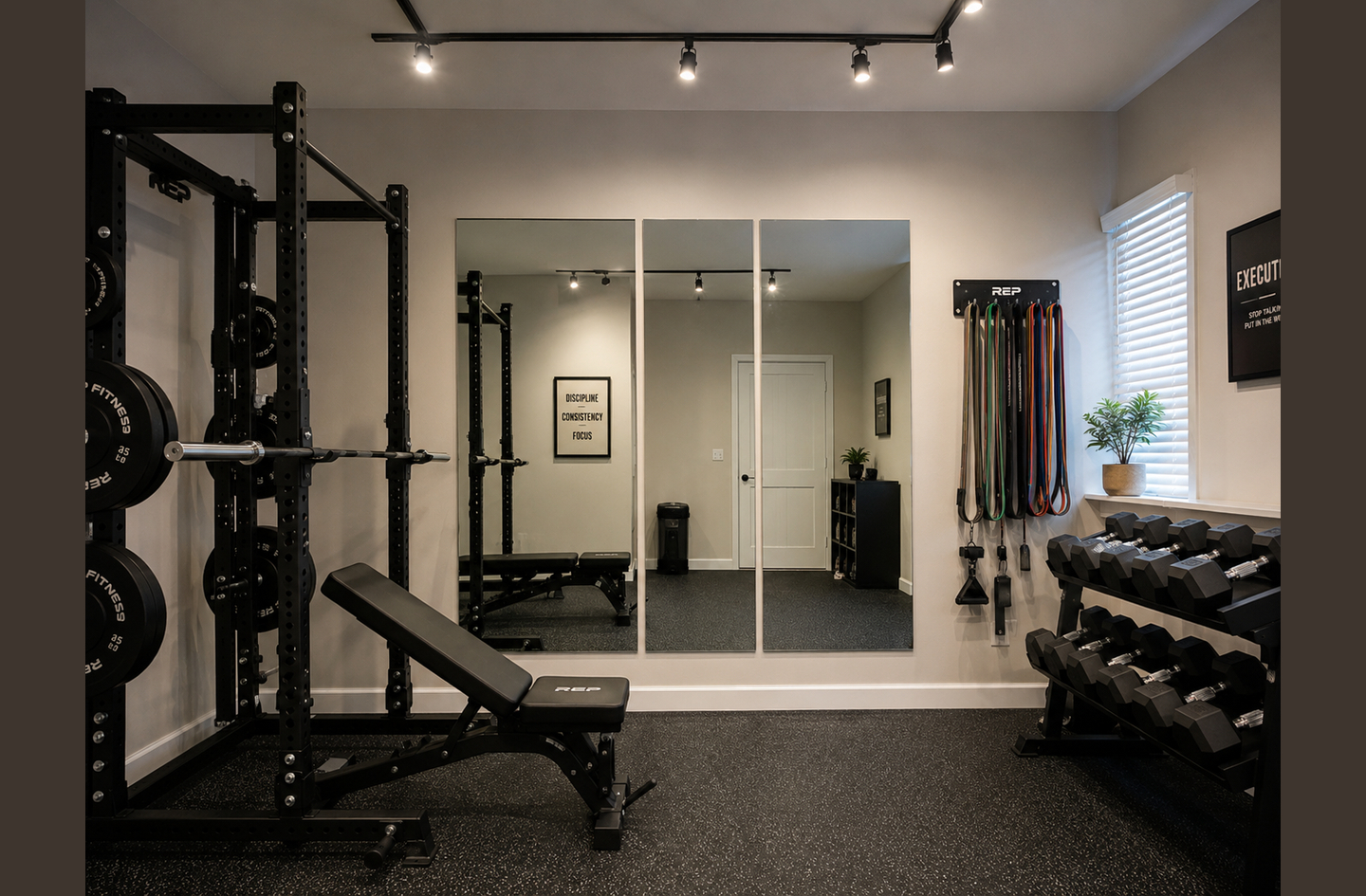
A correctly sized gym mirror does three things when the lifter steps into position. The panel captures the whole lifter at the planned stance width without the plates or elbows disappearing out of frame. The panel captures the planned vertical range: the hip crease at the bottom of the squat, the fingertip at the top of the overhead press, or the bar on the floor at a deadlift setup, depending on which lifts the mirror is for. And the sightline is clean: no seam crosses the eye line or the bar line, and no light fixture glares into the lifter’s eyes from the reflection.
Measured in panels, that usually looks like one of three setups. A single 48 by 72 inch panel at 12 to 18 inches mounting height covers a strength-only workflow. A 48 by 84 panel adds the overhead reach for a lifter who presses and has the ceiling to carry it. A pair of side-by-side 36 by 72 panels covers a lateral-movement setup. Each is correct for its workflow, and none is correct for all three.
The verifiable check is simple: step into the primary lifting position, run through the top of each planned lift, and confirm the reflection shows the body part the lift depends on. If any critical landmark falls outside the panel, the panel is too small, mounted wrong, or at the wrong distance; adjust one at a time and recheck.
Common Mistakes That Make a Mirror Useless
A mirror can be installed on the right wall, in the right room, at the right price, and still fail to do its job. The pattern across almost every bad install is the same: the mirror was sized before the lift was mapped. The following patterns show up again and again in home gym rooms:
Buying by wall length instead of by lift geometry
The common mistake is measuring the available wall and ordering a mirror to match. The useful dimension is the lifter’s loaded footprint and vertical range, not the wall. A 96 inch wall-to-wall panel at the wrong mount height still misses the overhead lockout, and a correctly sized 48 by 84 panel at the correct mount height catches the lift even on a 120 inch wall.
Treating a gym mirror like a bathroom mirror
The common mistake is buying a 1/8 inch unbacked panel from a hardware store because the price is lower. The gym panel sees falling weights, bar swings, and kettlebell impacts that a bathroom panel never sees, and the industry standard of 1/4 inch tempered glass with a safety backing exists for that reason8. The savings on glass become the cost of the install plus the second mirror.
Mounting height set to decorator convention
The common mistake is mounting the panel at the standard “furniture mirror” height of 32 to 36 inches above the floor, which hides the lower half of every squat and the bar at every deadlift setup. The strength-work range is 12 to 18 inches above the floor3, and floor-flush for yoga, Pilates, and ground-based movement.
Putting the seam right across the sightline
The common mistake is sizing the panels to the wall first and then letting the seams fall where they fall. A seam at the lifter’s eye line at setup, or at the bar path at the top of an overhead press, is visually loud enough to break the form check entirely. The planning sibling on mirror wall planning, panel size, and sightlines covers the seam-mapping method.
Placing a light source where the mirror reflects it into the lifter’s face
The common mistake is mounting a bright, undimmable fixture directly opposite the mirror wall. The reflected glare lands exactly where the lifter is trying to read bar path, which the room-first sibling on home gym lighting ideas that prioritize visibility addresses in detail. Walls before racks, airflow before cardio gear, lighting before mirrors, clearance before the first heavy set.
Frequently Asked Questions
What size mirror is standard for a home gym?
The industry-standard commercial gym panel is 48 inches wide by 72 inches tall in 1/4 inch glass with a safety backing2. That size captures a single lifter at a loaded standing stance for an average US adult; overhead work and lateral movement push the size up.
How high off the floor should a gym mirror be mounted?
For traditional strength work in a garage or home gym, the recommended mounting height is 12 to 18 inches above the floor3. Yoga, Pilates, and other ground-based practice want the panel flush with the floor so horizontal alignment stays in frame.
Does a home gym mirror need safety-backed glass?
For any panel inside the impact range of a dropped plate, a swung bar, or a kettlebell, safety backing is the floor8. The industry standard is 1/4 inch tempered glass with safety backing, and anything over 9 square feet is expected to meet Category II (ANSI Z97.1 Class A, 400 ft-lb impact)5.
Can several smaller mirror panels replace one large one?
Yes, as long as no seam crosses the sightline of a planned lift. Smaller panels are easier to carry, route around outlets and switches, and replace one at a time. A seam at the lifter’s eye line at setup or at the bar line at a lockout is visually loud and ruins the form check.
How far should the lifter stand from the mirror?
For a standing form check on squats, deadlifts, lunges, and standing presses, the lifting position should sit 6 to 8 feet off the glass7. Closer than that, the panel has to grow to catch the loaded stance; farther than that, reflection detail starts to drop.
Limitations and Edge Cases
- Vertical-reach and standing-height figures above come from US adult averages (CDC NHANES 2021-2023)1; a lifter at the 95th percentile for height needs 4 to 6 inches more panel, and a lifter under 5 foot 4 needs 4 to 6 inches less.
- Figures assume a wall-mounted panel; floor-standing full-length mirrors and portable gym mirrors on casters have different sizing and anchoring logic and are not covered here.
- Glass choice and backing choice interact with the room’s climate; for an unconditioned garage or a damp basement, see the sibling on garage mirrors and humidity, temperature, and impact before ordering.
References
Methodology: every figure below comes from an independent published source and links to the page that carries it; the article pairs manufacturer specifications and a US anthropometric dataset with a sport-governing-body rule, then layers Home Gym Specs’ room-first planning analysis on top.
- U.S. Centers for Disease Control and Prevention, National Center for Health Statistics – FastStats, Body Measurements for Adults Age 20 and Over, measured data collected 2021 to 2023.
- Fab Glass and Mirror – Gym Mirrors vs. Hardware Store Mirrors, sourcing guide, 2024.
- Fab Glass and Mirror – How High to Hang Gym Mirrors, strategic placement guide, 2024.
- EngineerFix – How Heavy Is a Mirror? Calculating the Weight, by the EngineerFix editorial team, 2024.
- iDigHardware (Lori Greene, AHC, FDAI, FDHI, CDC) – Glazing Identification, discussion of 16 CFR 1201 Category I/II and ANSI Z97.1 Class A/B impact testing, 2013.
- Powerlifting To Win – Powerlifting Squat Rules, quoting the International Powerlifting Federation (IPF) Technical Rules Book definition of legal squat depth.
- Hamilton Home Fitness – Home Gym Mirror Size: How Big and How High to Mount, 2024.
- Dulles Glass – Custom Gym Mirrors, manufacturer specifications for 1/4 inch glass with safety backing.
Conclusion
The right home gym mirror size is a geometry answer, not a wall answer. Measure the lifter-to-wall distance, the vertical range of the lifts planned, and the horizontal spread of a loaded stance, then pick a panel count and a glass class that keep the sightline clean and the install anchored to a wall that can hold the weight. When the decision involves anchoring load into drywall, block, or concrete, that is a licensed-contractor question, not a shopping question.
For how the mirror sits inside the broader lighting and reflection plan, see the overview in Home Gym Lighting and Mirrors.