Small home gym equipment gets dismissed as light-duty, but the category has shifted. With 21% of Americans now owning a home gym, outpacing the 18% who hold a gym membership2, equipment makers have responded with folding racks, modular benches, and full-diameter plates in formats that fit a spare bedroom or one-car garage. This article accompanies the strength zone design overview and covers seven pieces that hold meaningful load in a tight footprint. The standard for inclusion: each piece must support squat, press, or pull patterns at weights sufficient for strength adaptation, not just light conditioning or cardio.
Quick Answer
What small home gym equipment actually handles real lifting loads?
A folding half rack, a 7-foot Olympic barbell, bumper plates, an adjustable bench, adjustable dumbbells, heavy resistance bands, and a landmine attachment together cover squats, presses, and pulls with sufficient load capacity for strength adaptation. The American Council on Exercise identifies free-weight training as requiring as little as 20 to 50 square feet4, which means a standard spare bedroom holds a capable lifting setup when the pieces are chosen for compact footprints and real load ranges.
Key Takeaways
- A half rack and bench combination uses approximately 50 square feet of functional floor area, within range for most spare bedrooms and compact garage bays.
- Exercise and exercise equipment accounted for an estimated 564,845 injuries in 2024, an increase of 17% from the prior year6 – most linked to clearance failures, not equipment defects.
- Peer-reviewed resistance training research confirms that strength adaptation occurs across a wide load spectrum7, which means compact equipment with moderate plate capacity is physiologically sufficient for progressive training.
Space Realities: What a Tight Room Can Support
Before the equipment list, the room deserves a measurement pass. A 10-by-10-foot spare bedroom offers 100 square feet of floor. That sounds limited, but it substantially exceeds the 20-to-50-square-foot minimum the American Council on Exercise identifies for free-weight training4. The real constraints in compact spaces are rarely total area. They are ceiling height for overhead movements, clearance depth behind the bar for rack-out and step-back, and walking-path width around the equipment for safe transitions between lifts.
The squat rack market reflects this shift. Industry analysis published in 2025 notes that “home fitness demand tilts toward half racks and squat stands where space constraints and ceiling height limit full enclosure deployment”5. The folding and wall-mount segment is growing faster than freestanding full power cages precisely because compact configurations reduce the standing footprint to under 12 inches of wall projection when folded. The chart below combines ACE space guidelines with published rack clearance data to show where five progressive setups land.
A 55-square-foot lifting zone fits comfortably inside a one-car garage bay shared with a vehicle, a finished basement section, or a spare bedroom with the furniture cleared. That footprint supports all three movement patterns this article targets: squat, press, and pull. The planning sequence matters as much as the equipment list: measure the room and map the walking paths before anything else.
Ceiling height matters more than floor area
Overhead press in a compact room requires at least 10 to 11 feet of clear ceiling height, accounting for arm length, the bar height at lockout, and a few inches of safety margin. At 8 to 9 feet of ceiling clearance, the standing overhead press moves to a seated or kneeling variation, and pull-up attachments on rack uprights become the primary vertical pulling option. Map the ceiling before adding any rack that carries upright extensions or pull-up bars.
Floor condition sets the load ceiling
Concrete slabs, reinforced wood subfloor over rated joists, and well-bonded rubber stall mats each absorb the downward force of a planted barbell set differently. A residential floor system that has not been evaluated for the point load of a loaded rack may warrant a review by a licensed contractor or structural engineer before heavy drops or repeated impact loading begins. That evaluation is outside the scope of this equipment guide, but it belongs early in the planning order, well before the rack is ordered.
1. Folding Half Rack – Best for Squat Work in a Tight Footprint
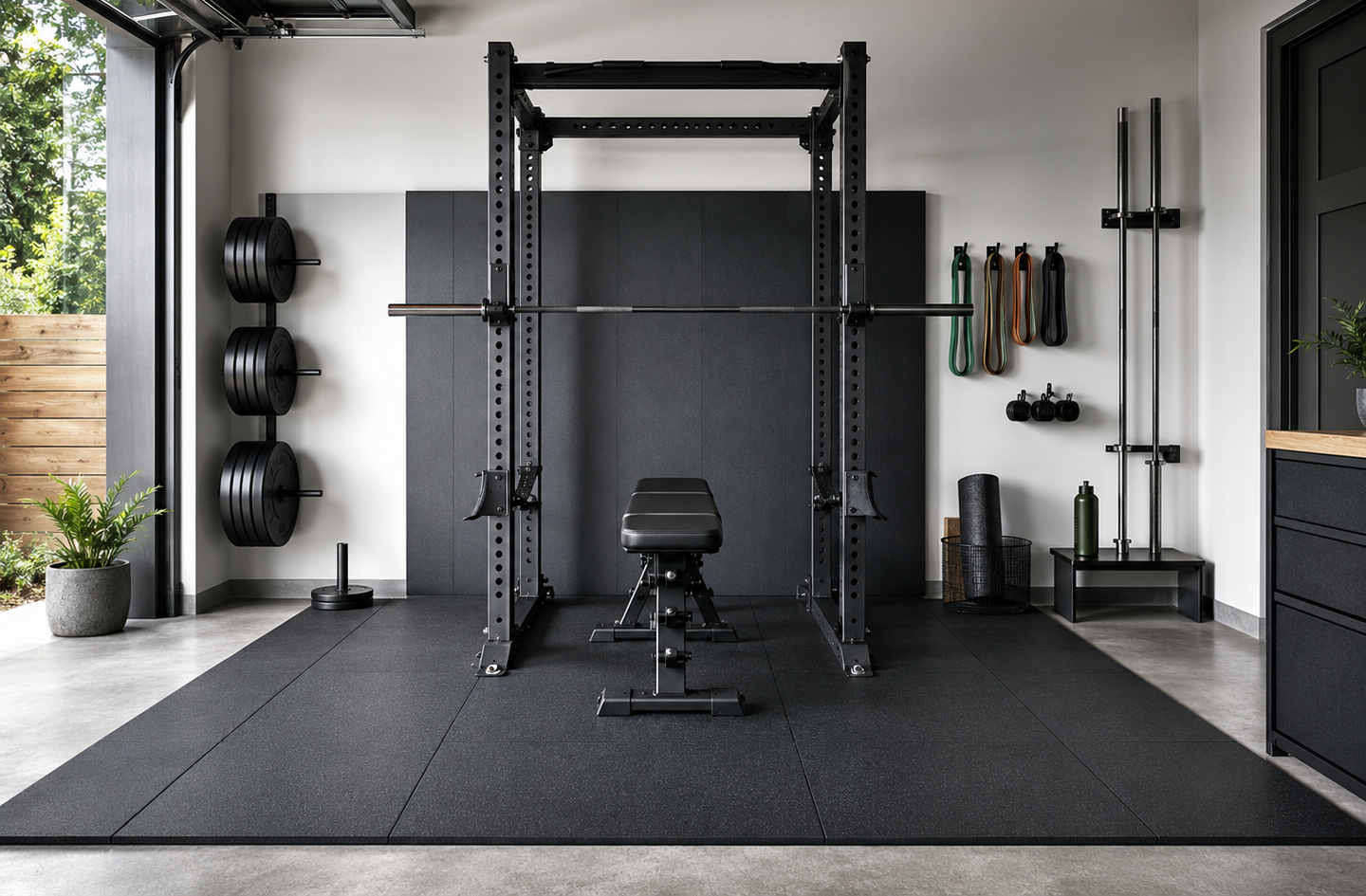
A folding half rack is the anchor piece for a small home gym that needs to support a loaded barbell squat. Standard freestanding full power cages occupy 4 to 5 feet of depth and stay in place permanently. A wall-mounted folding half rack reduces that to under 12 inches of wall projection when folded and 3 to 4 feet of usable depth when open. That difference allows the room to serve other purposes between sessions: the rack folds flat, the floor clears, and the space returns to its secondary use. Most current designs support rated loads of 500 to 1,000 pounds on the J-cups, which covers the training range of most recreational to serious strength athletes who train at home.
Why it earns its place
The folding half rack provides safety catches at adjustable heights, which removes the need for a spotter on heavy squats and allows controlled failure at the bottom of the lift. Without catches, a missed squat in a tight room with limited exit space carries real injury risk. The catch system is the difference between a strength exercise and an unsafe one in a compact layout. For anyone training alone in a small gym, it is the most important safety feature in the entire setup.
Room-readiness check
Wall-mounted racks anchor into studs or masonry with hardware rated for the intended load. Drywall alone does not carry that load; the wall type and anchoring surface require assessment before installation. If the wall is framed lumber with standard drywall, a licensed contractor or structural engineer can confirm whether the stud spacing and stud depth suit the bracket hardware specified for the rack model being considered. That check belongs before purchase, not after arrival. Do not assume a wall is ready until it has been assessed for the specific load.
2. Seven-Foot Olympic Barbell – Best for the Core Load Pattern
A 7-foot 45-pound Olympic barbell is the load-delivery tool for squats, deadlifts, bench press, overhead press, and bent-over rows. No substitute in a compact home gym carries the same range of compound movement patterns from a single implement. For a tight space, the relevant dimension is not the 7-foot bar length itself (which is fixed) but the collar-to-collar sleeve length of roughly 51.5 inches that determines how many plates can be loaded and whether the bar clears a wall-mounted rack bracket when racked. In most standard half-rack configurations, the bar-end clearance to a wall is documented by the rack manufacturer in their installation specifications and should be confirmed against the actual room dimensions during the planning phase.
Why it earns its place
The barbell is the only tool on this list that allows progressive overload across the full squat, press, and pull movement spectrum without a fixed increment ceiling. Adjustable dumbbells top out at 52.5 to 90 pounds per hand. The barbell, loaded to the available plate supply, can exceed that ceiling by a significant margin, which is why strength programming for the lower body and posterior chain almost universally centers on the barbell rather than dumbbells or bands. In a compact gym where every piece must justify its floor claim, the barbell’s movement range per square foot ratio is unmatched.
Room-readiness check
A standard 7-foot bar extends beyond the width of most residential doorways, so it enters and exits a room through the widest available opening or is stored inside the space permanently. Wall-mounted horizontal barbell storage keeps it off the floor, reduces injury risk from a bar in the walking path, and frees the floor area beneath the storage point. Confirm the storage location fits the full 86-inch bar length plus bracket clearance before the bar is purchased and delivered.
3. Bumper Plates – Best for Heavy Sets in a Small Room
Bumper plates are vulcanized rubber discs with a steel insert at the hub, designed to absorb the impact of a dropped or set-down barbell rather than transmitting force directly into the floor. In a compact home gym where the floor is residential subfloor, including finished concrete, plywood over joists, or a concrete slab with rubber mats, bumper plates reduce floor stress and vibration on a missed lift or a controlled drop at the end of a set. Iron plates are denser per inch of diameter, which is useful when a rack sleeve’s length limits how many plates can be loaded, but they transmit force abruptly and are not designed for dropping.
Why it earns its place
For the three movement patterns this article covers, the ability to set the bar down or drop it on a missed rep matters most in the deadlift and overhead press. In a tight room with no spotter and limited exit room, a controlled drop to the rubber mat behind the lifter is safer than grinding to failure with iron plates on a bar that may fall sideways. Bumper plates make the controlled drop a normal part of the set, not an emergency. That distinction is practical in a room where the margin for error is smaller than in a commercial gym.
Room-readiness check
A single pair of 45-pound bumper plates measures approximately 17.7 inches in diameter, which sets the loaded bar height on a deadlift at the standard pulling height of about 8.75 inches from the floor regardless of total load. That consistent pull height matters in a small room because the bar path and lifter position are predictable session to session. Store plates vertically on a dedicated weight tree or wall-mounted plate pegs rather than stacked on the floor, where they block walking paths and create a trip hazard in a tight layout.
4. Adjustable Flat-to-Incline Bench – Best for Press Work in a Compact Layout
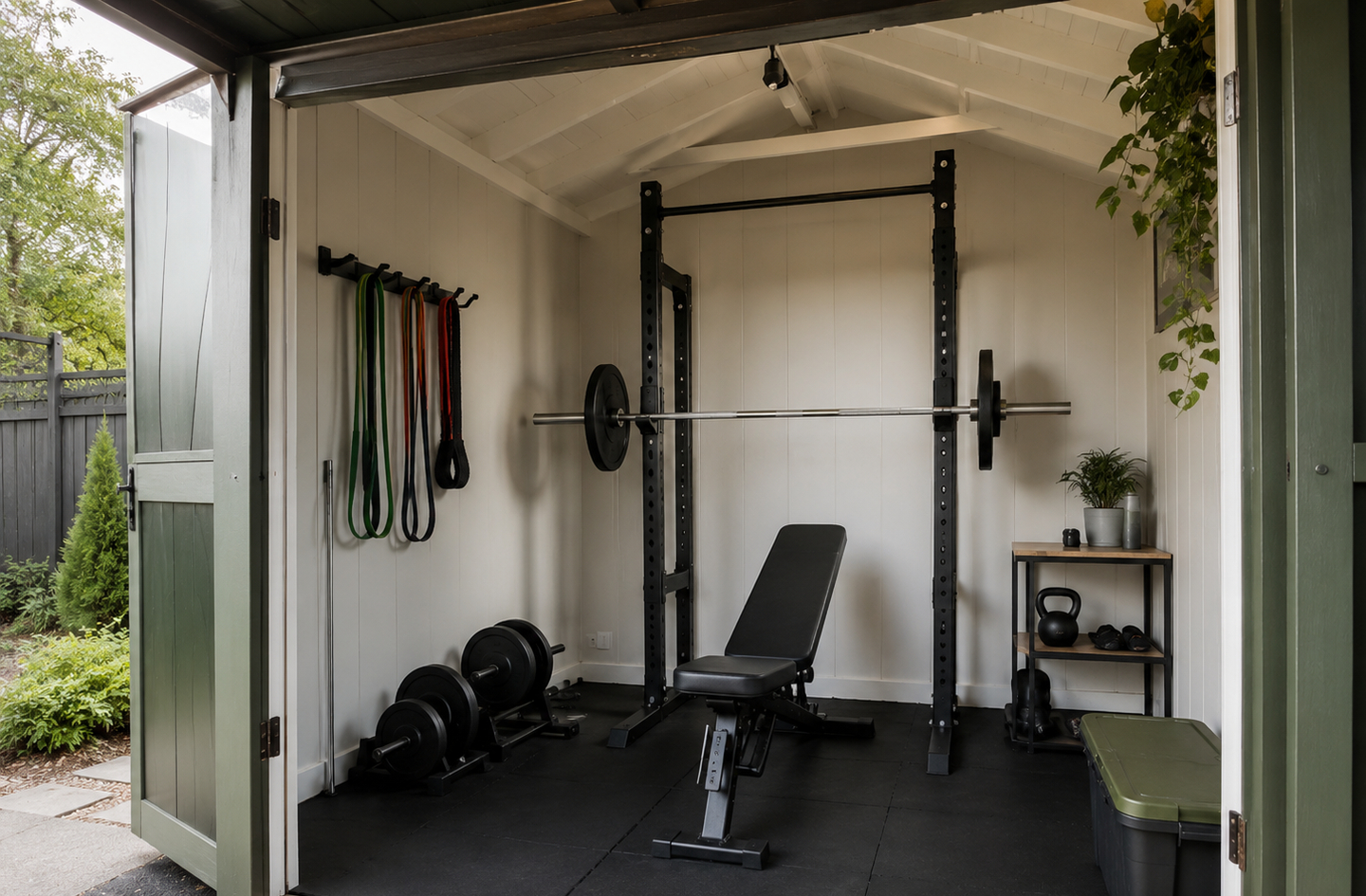
A press station in a compact gym requires a bench that adjusts from flat through multiple incline positions, with a base width appropriate to the room’s walking paths. Standard fixed flat benches run about 10 to 17 inches wide by 47 to 51 inches long. An adjustable bench covers that range plus incline positions for upper chest development and dumbbell row leverage, replacing what would otherwise be two or three separate fixed benches. Folding adjustable models add a storage configuration, folded upright against a wall or rack upright, that further reduces the footprint between sessions. The result is one piece that serves bench press, incline press, shoulder press (seated), dumbbell row, and Bulgarian split squat without occupying separate floor zones for each.
Why it earns its place
No other single piece in this list supports as many distinct movement patterns across the squat-adjacent, press, and pull categories. In a small gym where each item must justify its floor claim, coverage per square foot is the standard – and the adjustable bench covers more movement patterns than any other tool on this list. For programs built on compound movement variation rather than machine isolation, that range of function is essential rather than optional.
Room-readiness check
The bench should leave at least 24 to 36 inches of clear floor on both long sides so the lifter can move safely to and from the bar and exit the lift on a failed rep. When the bench is positioned inside the rack for barbell press work, the rack’s safety catch height and the bench’s pad height must align so that a failed press can be caught without the lifter being trapped beneath the bar. Set this geometry up at light working weights before loading heavy, and confirm it from a position on the bench before the heaviest sets.
5. Adjustable Dumbbells – Best for Unilateral Pulls and Press Accessories
Adjustable dumbbells consolidate what would otherwise be a wall-length rack of 15 to 20 fixed pairs into two handles with a selector mechanism. The storage cradles occupy roughly 14 to 16 inches in length by 9 to 10 inches in width each, compressing what was a 12-foot wall installation into a footprint smaller than a single fixed pair. In a tight gym, that compression frees the remaining wall length for plate storage, band anchors, or open walking path. Current selector-style adjustable models range from 5 to 52.5 pounds or 5 to 90 pounds per hand, with upper-range models capable of loading that supports single-leg Romanian deadlifts, heavy dumbbell rows, incline dumbbell presses, and Bulgarian split squats at meaningful working weights.
Why it earns its place
The pull pattern in a compact gym without a cable machine relies primarily on dumbbell rows, band pull-aparts, and band pull-downs to cover the lat, rhomboid, and rear delt work that a cable machine would otherwise handle. Adjustable dumbbells at the upper weight range (70 to 90 pounds per hand) support heavy single-arm rows that approach barbell row loads for many lifters at intermediate to advanced training stages. That makes them the primary unilateral pulling tool in a compact layout, and the primary accessory pressing tool for incline and shoulder variations when the barbell is used for heavier compound sets.
Room-readiness check
Adjustable dumbbells require firm, level placement for the selector mechanism to function correctly and safely. Cradles on rubber mat over a level concrete floor work well; cradles on an uneven or soft surface can cause the selector plate to engage incorrectly, creating a load failure mid-set. Confirm the cradle surface is level and stable before each session. The selector dial should move freely and lock at each increment before the weight is lifted from the cradle.
6. Heavy Resistance Bands – Best for Cable-Substitute Pull Patterns
Resistance bands in the heavy and extra-heavy resistance range, typically producing 65 to 120 pounds of tension at full stretch, serve as the cable-machine substitute in a compact gym that cannot accommodate a free-standing functional trainer. Anchored at door frame plates, rack uprights, or wall-mounted eye bolts, heavy bands support face pulls, banded pull-downs, banded rows, pull-aparts, and pull-throughs – the accessory pull and posterior chain exercises that barbell and dumbbell work leaves partially unaddressed. Research consistently supports their inclusion: peer-reviewed work published in Frontiers in Sports and Active Living confirms that “muscular adaptations can be obtained, and in some cases optimized, across a wide spectrum of loading zones”7, including band-resistance loading. The 2026 ACSM Resistance Training Position Stand reinforces this directly.
“Utilizing tools such as elastic bands, bodyweight exercises, and home-based routines yield marked benefits.”
American College of Sports Medicine, 2026 Resistance Training Position Stand8
Why it earns its place
Bands address the missing pulling arc in a barbell-and-dumbbell setup. A barbell bent-over row and a single-arm dumbbell row load the horizontal pull pattern but do not replicate the vertical pull angle (cable pull-down) or the face-pull angle (horizontal pull with external rotation) that a cable machine handles. Heavy bands anchored at height replicate those angles well enough to maintain balanced shoulder and upper-back development without a dedicated cable station, without a machine footprint, and without a dedicated electrical outlet for a cable stack.
Room-readiness check
Anchor points for heavy bands must be rated for the tension the band produces at full stretch. A door frame plate designed for light bands can fail under a 120-pound band pulled to full extension. Rack upright anchors at rated attachment points are the safest option in a compact gym because they are already rated for the rack’s intended load class. Wall-mounted anchor plates require the same wall-type assessment noted for the folding rack: stud placement, hardware rating, and the assessed load capacity of the wall assembly all matter before heavy band work begins.
7. Landmine Attachment – Best for Row and Press Variation in a Corner
A landmine attachment is a pivoting sleeve that accepts one end of a standard barbell, turning the free end into a loaded lever arm. Mounted to the base of a rack upright or anchored to a floor plate in a corner, the landmine enables T-bar rows, landmine presses, single-leg Romanian deadlifts, and rotation-based core loading, all from a footprint roughly the length of one barbell radius from the pivot point. No other piece in this list generates as much exercise variation from as small a static footprint, which makes it particularly useful when the available training area is a corner rather than an open rectangle. It is also the lowest-cost addition on this list, often available as a bolt-on accessory for existing rack uprights.
Why it earns its place
The T-bar landmine row is the closest horizontal pull pattern to a cable seated row that can be performed without a cable station. It loads both the horizontal pulling angle and significant scapular retraction under load, addressing the same muscle groups as a close-grip seated cable row. In a compact gym where the pull pattern relies on barbell bent-over rows, dumbbell rows, and bands, the landmine row adds a third distinct pulling stimulus and a unique braced-torso loading angle without adding a machine footprint. For posterior chain development in a small gym, it earns more than its floor claim.
Room-readiness check
A floor-plate landmine attachment requires the barbell to sweep a roughly 6-foot arc during movements like the landmine press. Map that arc before positioning the attachment: the bar tip must clear any wall, rack upright, or stored equipment through the full range of motion of each planned exercise. When the landmine mounts directly to a rack upright, the available sweep arc narrows and the movement pattern options shift accordingly. Confirm both the attachment position and the full movement arc at an unloaded bar before the first loaded set.
Small Home Gym Equipment: Space and Coverage Comparison
| Piece | Min. Floor Area | Primary Movement Pattern | Approximate Load Ceiling | Anchor Required |
|---|---|---|---|---|
| Folding half rack | ~24 sq ft (open) | Squat, rack pull | 500-1,000 lb rated | Yes (studs or masonry) |
| 7-ft Olympic barbell | 7 ft clearance | Squat, deadlift, press, row | Plate-supply limited | No |
| Bumper plates | Plate tree or wall pegs | Any barbell lift | No ceiling (additive) | No |
| Adjustable bench | ~14 sq ft (in use) | Bench press, row, split squat | 600-1,000 lb rated | No |
| Adjustable dumbbells | ~2 sq ft (cradles) | Unilateral press, row, hinge | Up to 90 lb per hand | No |
| Heavy resistance bands | Anchor point only | Pull-down, face pull, row | 65-120 lb tension | Yes (rated anchor) |
| Landmine attachment | ~7 sq ft (bar arc) | T-bar row, landmine press | Plate-supply limited | Rack mount or floor plate |
How We Evaluated These Pieces
The evaluation started from the premise that a compact gym is a differently constrained gym, not a compromised one. Seven pieces were assessed against four criteria: movement pattern coverage (squat, press, and pull must all be addressable), minimum floor footprint per piece in its active configuration, meaningful load ceiling sufficient for progressive strength adaptation rather than conditioning only, and storage integration (whether it can be stored compactly when not in use). No piece on this list was selected based on affiliate commission rates, and no manufacturer paid for placement. Readers should know that some product links on this site are affiliate links, which means a small commission may be received if a purchase is made, at no additional cost to the reader.
The broader market context supports the direction of this equipment set. The global home fitness equipment market reached an estimated $12.88 billion in 2025 and is projected to grow to $22.99 billion by 2034 at a 6.81% CAGR1, with significant investment directed toward compact and folding formats. Strength activity participation hit a new high in 2024, with every activity in the strength category increasing for the first time since the pandemic3. Both trends mean the available equipment in this category is measurably better in load rating, footprint, and build quality than comparable pieces from five years ago.
Frequently Asked Questions
What is the most important piece of small home gym equipment for strength training?
A barbell paired with a half rack and bumper plates is the foundation. A standard 7-foot Olympic barbell supports squats, deadlifts, bench press, overhead press, and bent-over rows from a single implement, covering every primary strength pattern. The half rack provides the safety catches that make solo barbell work viable in a compact room. Everything else on this list adds movement range or fills gaps the barbell cannot cover alone.
How much floor space do I need for a home gym that supports squats and presses?
Free-weight training requires as little as 20 to 50 square feet per the American Council on Exercise4. Adding a folding half rack and adjustable bench brings the functional zone to roughly 50 to 55 square feet. A 10-by-10-foot spare bedroom (100 sq ft) comfortably accommodates a complete squat-press-pull setup, with room for safe transitions and walking paths around the equipment.
Can resistance bands replace a cable machine in a small home gym?
Heavy bands (65 to 120 pounds of tension) replicate the pulling angles a cable machine covers, including face pulls, pull-downs, and horizontal rows. They do not match the constant-tension profile of a cable stack through a full range of motion, but resistance training research confirms that band-based loading produces meaningful strength and hypertrophy adaptations7. For a compact gym without the floor area for a cable machine, heavy bands are a capable substitute for most accessory pulling patterns.
Do I need bumper plates or can I use iron plates in a compact home gym?
Iron plates are denser per inch of diameter and fit more load on a shorter sleeve, but they are not designed to be dropped and transmit more impact to residential floors on a controlled set-down. Bumper plates are recommended for home use over concrete or residential subfloor because they absorb impact, protect the bar’s knurling and sleeves, and make a controlled floor contact a normal part of training rather than an emergency. If the floor has been assessed and rated for repeated impact loading, iron plates are a usable option for rack-based work where the bar is never dropped.
Is a folding half rack as safe as a full power cage for home training?
A folding half rack with properly rated catches, anchored per manufacturer specifications into confirmed stud or masonry, provides the same essential safety function as a full power cage: controlled failure at catch height on a missed lift. The key variable is installation quality, not the open-back design. Wall anchors that do not meet the rack’s load specification are the primary safety concern. A licensed contractor can confirm whether the wall construction suits the anchoring hardware before the rack is installed and loaded.
Limitations and Edge Cases
- Space figures are derived from ACE guidelines and published clearance data, not from a site-specific structural or floor-load assessment. Room measurements and floor condition evaluations belong to the planning process for each specific space.
- Load ceilings for bumper plates and the barbell are limited by sleeve length and available plate supply. Competitive powerlifters approaching elite-level total loads may find a compact home setup undersupplied for their heaviest sets.
- The overhead press guidance assumes a minimum 10-to-11-foot ceiling. Rooms with 8-to-9-foot ceilings require seated or kneeling press variations and limit the pull-up attachments that can be used on a rack.
References
- Fortune Business Insights – Home Fitness Equipment Market Size, Share and Industry Analysis, 2025-2034.
- CivicScience – Four Fitness Trends to Watch in 2024. CivicScience, 2024.
- Sports and Fitness Industry Association – SFIA Topline Participation Report: 247.1 Million Americans Were Active in 2024. SFIA, 2025.
- ArchDaily – Tips for Home Gym Design: Fostering Physical and Mental Well-Being in Interiors (citing American Council on Exercise space guidelines). ArchDaily, 2023.
- Mark Wide Research – Squat Racks Market: Size, Share, Growth and Industry Analysis 2025-2034. Mark Wide Research, 2025.
- National Safety Council – Sports and Recreational Injuries, Injury Facts (citing NEISS/CPSC data). NSC, 2025.
- PubMed Central – Schoenfeld BJ, Grgic J, Krieger J, Haun CT. Loading Recommendations for Muscle Strength, Hypertrophy, and Local Endurance: A Re-Examination of the Repetition Continuum. Frontiers in Sports and Active Living, 2021.
- American College of Sports Medicine – Resistance Training Guidelines Update 2026: Position Stand on Resistance Training for Health and Fitness. ACSM, 2026.
Conclusion
A folding half rack, a 7-foot barbell, bumper plates, an adjustable bench, adjustable dumbbells, heavy resistance bands, and a landmine attachment collectively cover squats, presses, and pulls at meaningful loads from a combined functional footprint of roughly 55 square feet. None of these pieces require a dedicated full-time gym room or a commercial-scale floor plan. What they do require is a room that has been measured for ceiling height, walking-path width, and floor condition before the equipment arrives, and anchor installations that have been confirmed against the wall’s actual construction. The gear is not the first decision; the room is.
For the broader planning context, see the strength zone design overview for how equipment placement, clearance zones, and training flow connect across the full lifting space.