A low ceiling basement gym is not a compromise; it is a constraint that shapes every equipment and exercise decision you make. The Basement Gym Planning overview covers the full below-grade setup sequence. This article focuses on the specific equipment and exercise choices that let you train effectively when your floor-to-ceiling clearance sits between 7 and 8 feet. CivicScience tracking data from early 2024 found that 21 percent of Americans report owning a home gym.7 A large share of those spaces sit below grade, where ceiling height governs every equipment choice.
Quick Answer
What equipment and exercises work in a low-ceiling basement gym?
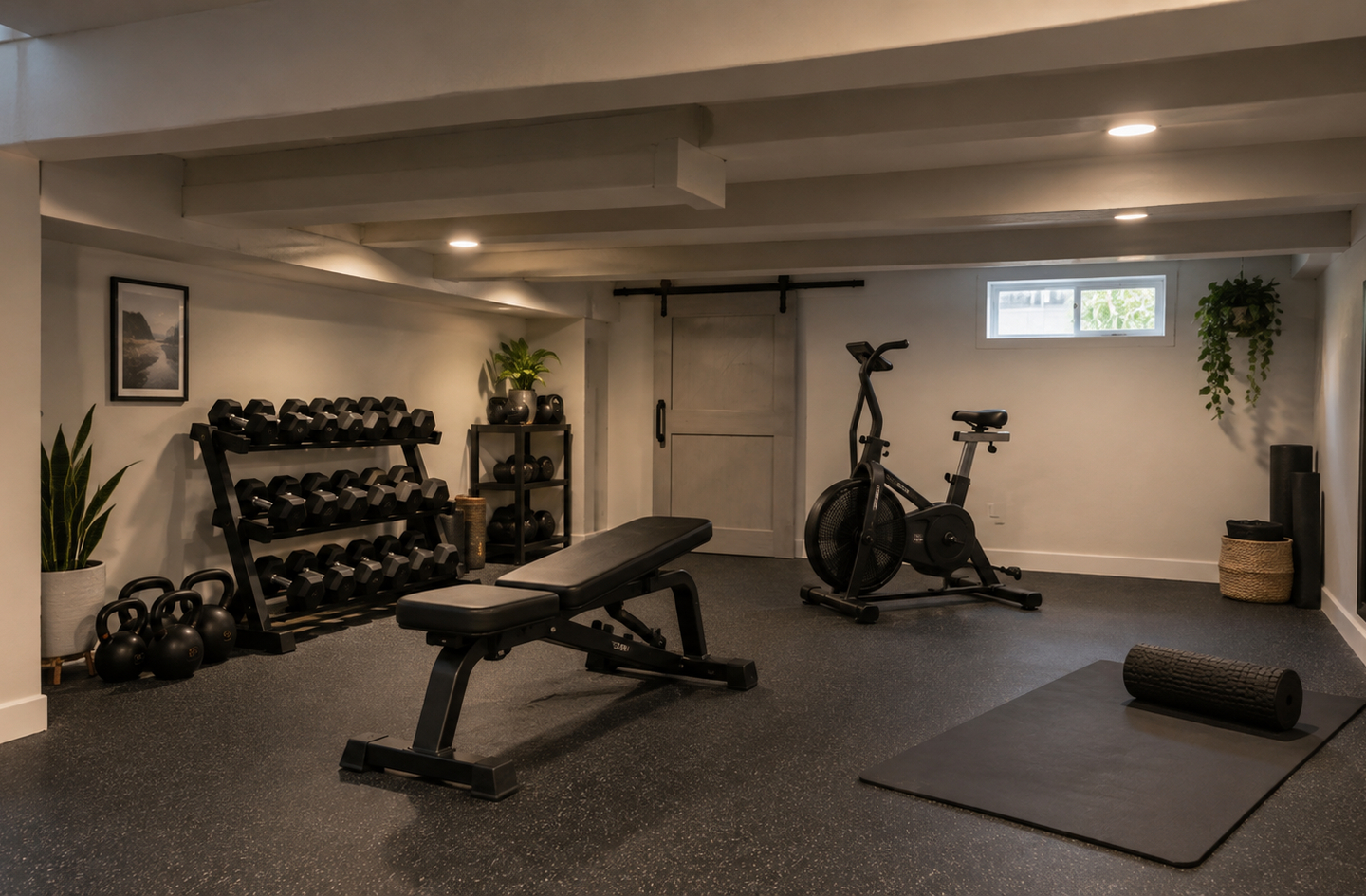
A basement with 7.5 to 8 feet of clearance supports a full strength training setup using short power racks (68 to 72 inches tall), squat stands, wall-mounted or compact freestanding cable systems, stationary bikes, and rowing machines.3 Standing overhead barbell pressing and standard pull-ups require 8.5 to 9 feet of floor-to-ceiling space, which exceeds most basement headroom,5 but the substitutions are practical and keep training volume high.
Key Takeaways
- The International Residential Code sets 7 feet as the minimum ceiling height in habitable basement spaces,1 so most finished basements fall between 7 and 8.5 feet of usable headroom.
- Short power racks (68 to 72 inches) and squat stands let you train squats, deadlifts, and bench press under an 8-foot ceiling without rack clearance conflicts.3
- Standing barbell overhead pressing needs 8.5 to 9 feet of clearance,5 making the landmine press, seated dumbbell press, and cable variations the practical substitutes in most basements.
- Cardio equipment, including air bikes, rowing machines, and most stationary cycles, works at seated or low-to-the-ground height and clears even 7-foot ceilings without issue.
Assess Your Clearance Before Choosing Equipment
Finished ceiling height is the measurement from the top surface of your gym flooring to the lowest fixed obstruction directly above your planned training zone. That point is often a beam, a duct run, or a light fixture, not the ceiling plane itself. Most residential basements built before 1980 were not designed with exercise in mind. The NAHB found that nearly half of US owner-occupied homes predate 1980,2 making sub-8-foot basement ceilings a widespread planning constraint. The International Residential Code requires a minimum of 7 feet in habitable basement spaces,1 so 7 to 8.5 feet is the practical range you are working within.
Measure at every point in the training zone, not just the center of the room. A 7 foot 10 inch average can hide a 7 foot 2 inch beam directly above where the barbell would travel. If you have not yet measured and mapped the low points in your basement, the beams and ducts layout guide covers that process in detail. This spoke assumes you have a measurement in hand and need to know which equipment and exercises actually fit.
One rule before anything else: the clearance that matters is not the ceiling height at the wall, or the average height of the room. It is the clearance at the specific point where each piece of equipment stands and each movement reaches its highest point. A 7.5-foot average ceiling with a 7-foot beam above the rack position means you are working with 7 feet, not 7.5 feet.
Short Power Racks and Squat Stands for Low-Ceiling Strength Training
The rack decision is the first one that matters in any basement strength zone, and in a low-ceiling basement it is more specific than in most rooms. Standard power racks stand 80 to 84 inches tall on average, and some models reach 90 inches.3 The rack height alone does not determine how much ceiling clearance you need for squatting or bench pressing inside it. But it does determine whether the uprights will fit under the floor joists, and whether loading the bar into the J-cups requires lifting it above the rack’s top crossmember.
A short power rack is a low-profile cage with an overall height of 68 to 72 inches, fitting beneath ceilings that block a standard-height rack.3 At that height, squats, bench press, and Romanian deadlifts all fit without overhead conflicts. The tradeoff is that shorter uprights reduce the J-cup range at the top, which limits tall lifters and overhead pressing inside the cage. In a low-ceiling basement, overhead pressing inside any rack is typically off the table regardless of rack height.
A squat stand is a pair of independent posts supporting a barbell without a cage frame, typically 47 to 72 inches tall depending on the model. Squat stands use less floor space than a full rack and are generally easier to position under low or uneven ceilings. Squat stands also take up less floor space. Home Gym Life analyzed 130-plus racks and found the median squat rack footprint at 17.55 square feet versus 18.67 for a full power rack.4 That gap matters when every square foot counts.
Squat stands trade the protection of the cage structure for flexibility. Without side safety rails, you need either experienced lifting technique and good spotters, or a set of freestanding safety arms positioned at catch height. That is an acceptable tradeoff for many lifters, and squat stands are the most common choice for sub-7.5-foot ceilings where even short power racks press against the joists.
| Equipment type | Typical height range | Minimum ceiling needed | Best for |
|---|---|---|---|
| Full power rack (standard) | 80 to 90 inches | 8 ft or more | Taller ceilings, full safety cage |
| Short power rack | 68 to 72 inches | 7 to 7.5 ft | Squats, bench, deadlifts under low joists |
| Half rack (squat rack) | 70 to 82 inches | 7 to 7.5 ft | Squats and bench with open-front loading |
| Squat stands (pair) | 47 to 72 inches adjustable | 6 to 6.5 ft | Very low ceilings, flexible positioning |
The ceiling height above the rack position, not the rack’s maximum upright height, is the governing number. A short rack under an 8-foot ceiling gives you a functional squat and bench station; a standard rack under the same ceiling may not fit or may not allow you to load and unrack safely.
Compact Cable Systems That Work Under 8 Feet
A cable machine’s height requirements depend on the movement, not just the machine’s overall dimensions. Overhead cable exercises, like an overhead cable triceps extension or a high-cable press-down from the top pulley, extend the user’s reach above their standing height. Those movements are limited in the same way that barbell overhead pressing is limited. But the majority of cable work, including lat pulldowns, seated rows, cable curls, and face pulls, stays within a 7 to 8-foot ceiling when the machine is positioned correctly.
Wall-mounted functional trainers are the most ceiling-efficient cable option for a low-ceiling basement. These machines project only a few inches off the wall, occupy almost no floor footprint, and leave ceiling clearance above the user unobstructed during most movements. Freestanding compact cable towers are another option: many models stand under 7 feet tall with a small base footprint, compatible with a low-ceiling basement and a limited floor area.
The critical measurement for any cable system in a low-ceiling room is not the machine’s overall height but the height of the top pulley. A cable tower with a 78-inch top pulley allows lat pulldowns for a 6-foot user without overhead conflict. The same machine with an 84-inch top pulley starts to push against 7-foot ceiling clearance when overhead movements are combined with the user’s arm extension above the pulley anchor.
If ceiling height is genuinely a concern for a cable system, wall-mounted dual-pulley functional trainers are the strongest option. They mount to the wall at a height you control, their footprint is the wall surface they attach to, and the pulleys anchor at whatever height your wall space allows. The anchoring surface must be adequate for the loads involved. A licensed contractor should assess the wall before any cable system is bolted to concrete block or unverified framing.
Low-Profile Cardio Equipment for Limited Headroom
Most cardio equipment for a home gym has far lower ceiling clearance requirements than any barbell movement, and many machines are suitable for even 7-foot ceilings. The exception is the treadmill, which requires a specific clearance calculation based on the user’s height and the machine’s deck height.
Air Bikes and Stationary Cycles
An air bike or a conventional stationary cycle requires roughly the height of a seated adult plus a few inches of overhead space for head movement during hard pedaling efforts. A 7-foot ceiling creates no conflict for any standard air bike or upright stationary cycle. Even a seated rower clears a 7-foot ceiling comfortably since the movement is entirely horizontal.
Rowing Machines
A rowing ergometer is the lowest-clearance cardio option in a home gym. The drive and recovery stroke are both at or below seat height, and at the peak of the catch position, the user’s peak height above the floor is roughly seated torso height. A 7-foot ceiling is more than sufficient.
Treadmills and the Ceiling Clearance Formula
Treadmills require more headroom than most people expect. The deck sits above the floor (usually 5 to 7 inches), and the user stands on the elevated deck. The total clearance requirement is the sum of the user’s height, the deck height, and a safety margin of at least 4 to 5 inches for runners. Treadmill Doctor’s guidance states to add the user’s height, the deck height, and at least 4 to 5 inches of clearance for running.6 For a 6-foot user on a 6-inch deck, that is roughly 78 to 83 inches of floor-to-ceiling clearance. A 7-foot (84-inch) ceiling just barely accommodates a 6-foot runner. A 7.5-foot ceiling gives more comfortable margin. If the ceiling is at or below 7 feet, a rowing machine or stationary bike is the safer cardio choice.
Skip rowers, ski ergs, and elliptical trainers. Many elliptical models raise the user’s foot path at the top of the stride, and the total reach approaches 8 feet for taller riders. A low-ceiling basement is generally not compatible with a full-size elliptical.
Exercise Substitutions When Overhead Space Is Limited
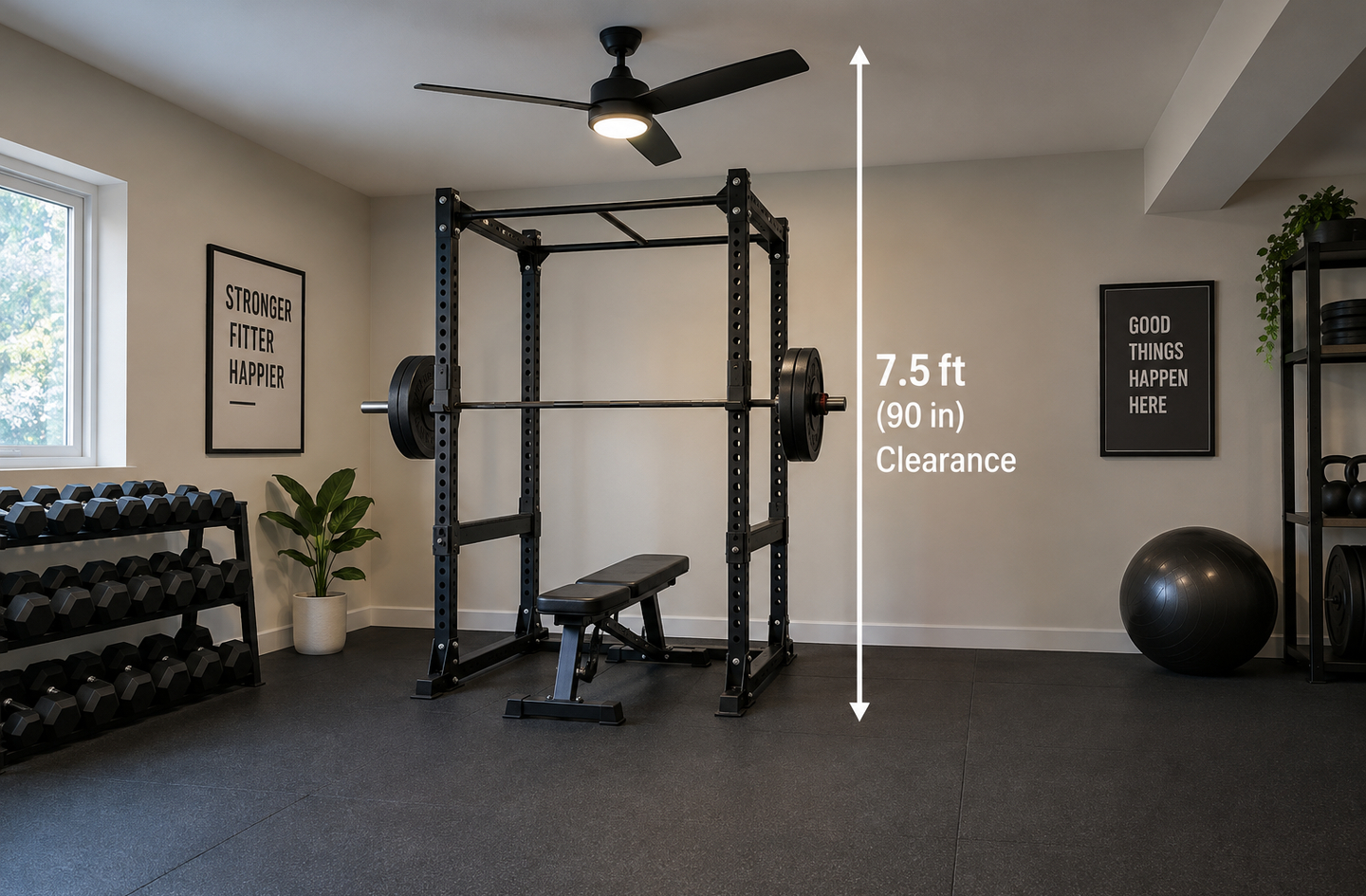
Losing the standing barbell overhead press is the most significant training adjustment in a low-ceiling basement, and it is the one most lifters resist. Overhead barbell pressing requires 8.5 to 9 feet of floor-to-ceiling clearance for an average-height adult,5 a range that exceeds most basement ceilings by several inches. The bar path on the way up extends above the lifter’s full standing reach, and any contact with a joist or duct ends the set. The substitutions below are not workarounds; they are exercises that load the shoulder press pattern effectively with the available headroom.
Seated Dumbbell Press
Seated dumbbell pressing reaches a lower peak height than standing barbell pressing because the lifter’s arm extension ends lower from a seated position. For most adults, seated dumbbell pressing clears a 7.5-foot ceiling comfortably. The movement trains the anterior deltoid and triceps through the same vertical press pattern and allows unilateral loading, which is a genuine advantage over the barbell version in many programs.
Landmine Press
The landmine press is performed with a barbell anchored at floor level in a sleeve or corner attachment, pushing the bar upward on a diagonal arc rather than straight overhead. The bar travels from chest height to roughly nose or forehead height, on a fixed arc. The peak height of the movement is significantly lower than a standing overhead press, making the landmine press one of the most practical shoulder press substitutes for a low-ceiling basement. It also loads the scapular stabilizers differently from a vertical press, which coaches often cite as an advantage for long-term shoulder health.
A landmine attachment requires a barbell sleeve anchored to the floor or wall. Some units sit in a weighted base without anchoring; others bolt to a platform. Either version is compatible with most low-ceiling basement setups.
Lat Pulldown as a Pull-Up Substitute
Standard pull-ups require 18 to 20 inches of clearance above the bar to prevent head contact at the top of the range.8 A comfortable bar height for a 6-foot lifter puts the bar at around 78 to 84 inches from the floor. That means the ceiling must be at least 96 to 104 inches high for safe pull-up training. Most basements fall short of this. A lat pulldown machine attached to a cable tower provides the same vertical pulling pattern without any overhead clearance requirement. Seated cable rows, band pull-aparts, and face pulls supplement the horizontal pulling work the back needs alongside vertical pulls.
Incline Press and Floor Press
Neither an incline barbell press nor a floor press requires significant overhead clearance. The incline press moves the bar on an angled path from chest level to a point a few inches above the lifter’s face, well within a 7.5-foot ceiling. The floor press, performed lying flat with a barbell, reaches only as high as the lifter’s arms extend from floor level. Both movements are effective substitutes for flat or overhead barbell pressing in low-ceiling rooms, and both shift emphasis to the upper and mid-chest depending on incline angle.
“For standard pull-ups and chin-ups, 18 to 20 inches of clearance above is the working minimum.”
Duonamic, independent fitness equipment guidance8
Exercises That Work Well With Limited Headroom
The substitution list above focuses on movements you lose access to. This section covers what you keep. Most of the high-value exercises in strength training clear a 7-foot ceiling easily, and a low-ceiling basement loses less training capacity than most people assume when they first measure the room.
Squats and All Barbell Hinge Movements
Squats, deadlifts, Romanian deadlifts, good mornings, hip thrusts, and all barbell hinge patterns require no overhead clearance beyond the standing height of the lifter. None of these movements lift the barbell above shoulder height, and none of them depend on ceiling space at all. A low-ceiling basement is fully functional for a strength program built around squats, bench press, and deadlifts. The ceiling does not touch any of those movements.
Horizontal Pressing
Flat bench press, close-grip bench press, floor press, dumbbell bench press, and all chest-supported pressing movements work under any ceiling height that allows the rack or bench to stand. The barbell in a flat bench press extends to roughly the height of the lifter’s extended arms above the bench, which for most people is well under 60 inches from the floor. An 84-inch ceiling provides more than 2 feet of overhead clearance above the bar path in any horizontal press.
Cable and Dumbbell Accessory Work
The large majority of isolation and accessory movements work within a low-ceiling environment without modification. Cable rows, face pulls, triceps pushdowns, cable curls, lateral raises, and all dumbbell work performed at or below shoulder height fit under a 7-foot ceiling for any realistic user. The exceptions are movements that explicitly extend above the head: cable overhead triceps extensions, dumbbell pullovers with full overhead reach, and anything that requires the user to raise their arms above their own standing height. Those substitutions are practical and the list of ceiling-compatible accessory movements is long.
Resistance Band Training
Bands are the most ceiling-agnostic training tool in a home gym. They anchor at floor level, at mid-height on a rack upright, or through a door frame, and produce resistance at any height you choose without approaching the ceiling. Banded squats, banded deadlifts, band pull-aparts, face pulls, and pallof presses work identically in a 7-foot basement and a 10-foot room. For lifters adapting a program that previously included standing overhead volume, bands are a fast way to maintain shoulder abduction and external rotation work without overhead clearance.
How to Lay Out a Low Ceiling Basement Gym
The layout process for a low-ceiling basement starts with a height map, not a floor plan. Before assigning any zone to any equipment category, walk the room and record the actual clearance at every major obstructions: beams, ducts, pipes, light fixtures, and any point where the floor joists above dip below the general ceiling plane. Mark the low points on a rough sketch.
Once you have that height map, the placement logic becomes straightforward. Position your tallest equipment under the tallest points in the room. If there is a beam along one side of the room, the power rack or squat stand goes on the opposite side. If a duct run drops the ceiling to 7 feet in one corner, that corner becomes your stretching and band work zone, not your rack zone. The rack needs the tallest clearance; the floor work can happen anywhere.
Keep the training path clear. In a small basement gym, it is easy to fill the available floor space and then realize there is no safe place to walk while carrying a loaded barbell from the rack to the bench area. Keep a clear walking path from the staircase to each primary training station. This is not optional: a tripping hazard between a loaded rack and a bench is a safety issue. For more detail on working around fixed basement obstacles, see the fixed obstacle layout guide.
Storage belongs on the walls and on the rack itself, not in the floor plan. Plates on a weight tree next to the rack, dumbbells on a wall-mounted or low-profile floor rack, and bands on a hook are all storage solutions that do not consume training zone floor space. If you have a moisture concern in the space, the article on the basement gym moisture check covers what to assess before putting equipment in place. For broader small-space layout ideas, the article on small basement gym ideas with storage addresses equipment combinations and zone planning in compact below-grade rooms.
Clearance is equipment in a low-ceiling basement. The square footage on the floor matters; the cubic footage above each training zone matters more. Planning around vertical constraints first prevents the common scenario where a rack fits in the room but the exercises it was purchased for do not.
Common Setup Mistakes in Low-Ceiling Basements
Most low-ceiling basement gym mistakes happen before a single piece of equipment is purchased. They are planning errors, not installation errors.
Buying a Standard-Height Rack First
A standard power rack at 82 to 84 inches physically fits under most 7-foot-plus ceilings with a few inches to spare. But loading a barbell into the top J-cup position, racking after a heavy squat, and safely un-racking in a low ceiling room requires more clearance above the rack than the rack itself needs to stand. Lifters buy the rack, get it into the basement, and then discover they need to bend their knees and crouch to slide the bar in from the side rather than pressing it straight up onto the hooks. A short rack or squat stand solves this before it becomes a problem.
Measuring the Center of the Room Instead of the Training Zone
The ceiling height in the center of the basement is often the highest point in the room. Beams and duct runs along the perimeter or in the path of the training zone reduce the usable clearance significantly. Measure at the specific point where each piece of equipment stands and each movement reaches its highest point, not at the most favorable spot in the room.
Planning Overhead Exercises Without Accounting for the Movement Arc
The bar path on an overhead press does not go straight up from the starting position. It arcs slightly backward as it rises, which means the bar may contact a beam or joist that is behind and above the starting position rather than directly above. When assessing ceiling clearance for any overhead movement, trace the full arc of the bar path, not just the start and finish points. A 7.5-foot ceiling that appears to clear a standing shoulder press at the start position may not clear the midpoint of the arc.
Underestimating Treadmill Clearance
The treadmill is the most commonly mis-measured piece of cardio equipment in a home gym. Buyers check whether the machine fits the floor space and forget that the user stands on an elevated deck and must clear the ceiling with their full height plus a safety margin. Check the clearance formula for the tallest user who will run on the machine before purchasing: user height plus deck height plus at least 4 inches for running.6
Frequently Asked Questions
What is the minimum ceiling height for a basement home gym?
The International Residential Code sets 7 feet (84 inches) as the minimum habitable basement ceiling height.1 That minimum is enough for squats, deadlifts, bench press, and most cardio equipment for users under 5 feet 10 inches. Standing barbell overhead pressing and standard pull-ups need 8.5 to 9 feet and are not practical at the code minimum.
Can you do pull-ups in a basement with 8-foot ceilings?
Pull-ups require 18 to 20 inches of clearance above the bar at the top of the range.8 For an 8-foot (96-inch) ceiling, the bar must be mounted below 76 to 78 inches (about 6 feet 4 inches) for safe head clearance. At that mounting height, most adults cannot complete a full hanging dead-hang without their feet dragging. A lat pulldown machine is the practical substitute for a basement under 8.5 feet.
Will a standard power rack fit in a 7-foot-ceiling basement?
Standard power racks stand 80 to 84 inches tall, which physically fits under a 7-foot ceiling with 0 to 4 inches of clearance above the top crossmember.3 That margin is enough to stand the rack but not enough to safely load and unrack a barbell in a standard J-cup position. Short power racks at 68 to 72 inches, or squat stands, are the appropriate choice at 7 feet of ceiling height.
What cardio equipment works in a basement with low ceilings?
Air bikes, stationary cycles, and rowing machines all work comfortably at 7-foot ceiling heights because they are used from a seated position and require no overhead reach. Treadmills need more careful assessment: the clearance requirement is the user’s height plus the deck height plus at least 4 inches of safety margin.6 Full-size elliptical trainers are generally not compatible with ceilings below 8 feet.
What can I do instead of standing overhead press in a low-ceiling gym?
The landmine press, seated dumbbell press, incline barbell press, and machine shoulder press all work under 7.5 to 8-foot ceilings. The landmine press is the most space-efficient substitute: the bar travels on a short diagonal arc with a peak height well below a standing overhead press, and the attachment hardware takes up minimal floor space. Seated dumbbell pressing also works because the lifter’s arm extension peaks lower from a seated position than from standing.
Limitations and Edge Cases
- This article addresses equipment selection and exercise substitution for a low ceiling basement gym where the floor-to-ceiling measurement is between 7 and 8.5 feet. Basements below 7 feet are unusual in finished residential construction and may have additional constraints outside this scope.
- Clearance requirements in this article use typical adult proportions. Users significantly taller than 6 feet 2 inches should add their own height differential to all overhead clearance thresholds before selecting equipment.
- For the detailed measurement methodology behind how to measure usable headroom at each training zone, including beam, duct, and fixture adjustments, see the basement gym ceiling height measurement spoke.
References
Methodology: every figure below comes from an independent published source and links to the page or document that contains it; the article is reviewed against current source content before publication.
- Building Code Trainer – Minimum Residential Ceiling Heights Per the IRC, International Residential Code Section R305.1, 2021 edition.
- NAHB Eye on Housing – Almost Half of Owner-Occupied Homes Built Before 1980, American Community Survey data, March 2026.
- GarageGymPro – How Tall Are Power Racks? Space Requirements Explained, 2024.
- Home Gym Life – Squat Rack Dimensions: 130+ Racks Analyzed, 2024-2025.
- RitFit Sports – Best Home Gym Size Guide, 2024.
- Treadmill Doctor – How High Should My Ceiling Be for a Treadmill, July 2024.
- CivicScience – Four Fitness Trends to Watch in 2024, CivicScience tracking poll, February 2024.
- Duonamic – How High Should a Pull-Up Bar Be, fitness equipment guidance, 2024.
Conclusion
A low ceiling basement gym is functional for the large majority of strength and conditioning work. The ceiling shapes equipment selection, primarily the choice between a short rack and a standard rack, and eliminates standing overhead barbell pressing and standard pull-ups from the training menu. Those substitutions are practical. Squats, deadlifts, bench press, cable work, and seated cardio are unaffected by the ceiling and carry enough training volume that quality does not suffer. Plan the ceiling clearance first, then position tall equipment under the tallest points in the room. See the overview in Basement Gym Planning for how ceiling height fits into the broader below-grade setup sequence.