Most small home gym equipment is chosen by footprint alone. Then it fails the first heavy set, because the bar is longer than the room or nothing catches a missed rep. Free weights accounted for 90 percent of the injuries in one national emergency department study of weight training1. This guide is part of the strength zone design overview, which summarizes how the lifting area is planned. The narrower question here is which seven compact pieces still support squats, presses and pulls under real load inside a tight room.
Quick Answer
Which small home gym equipment handles real load in a tight room?
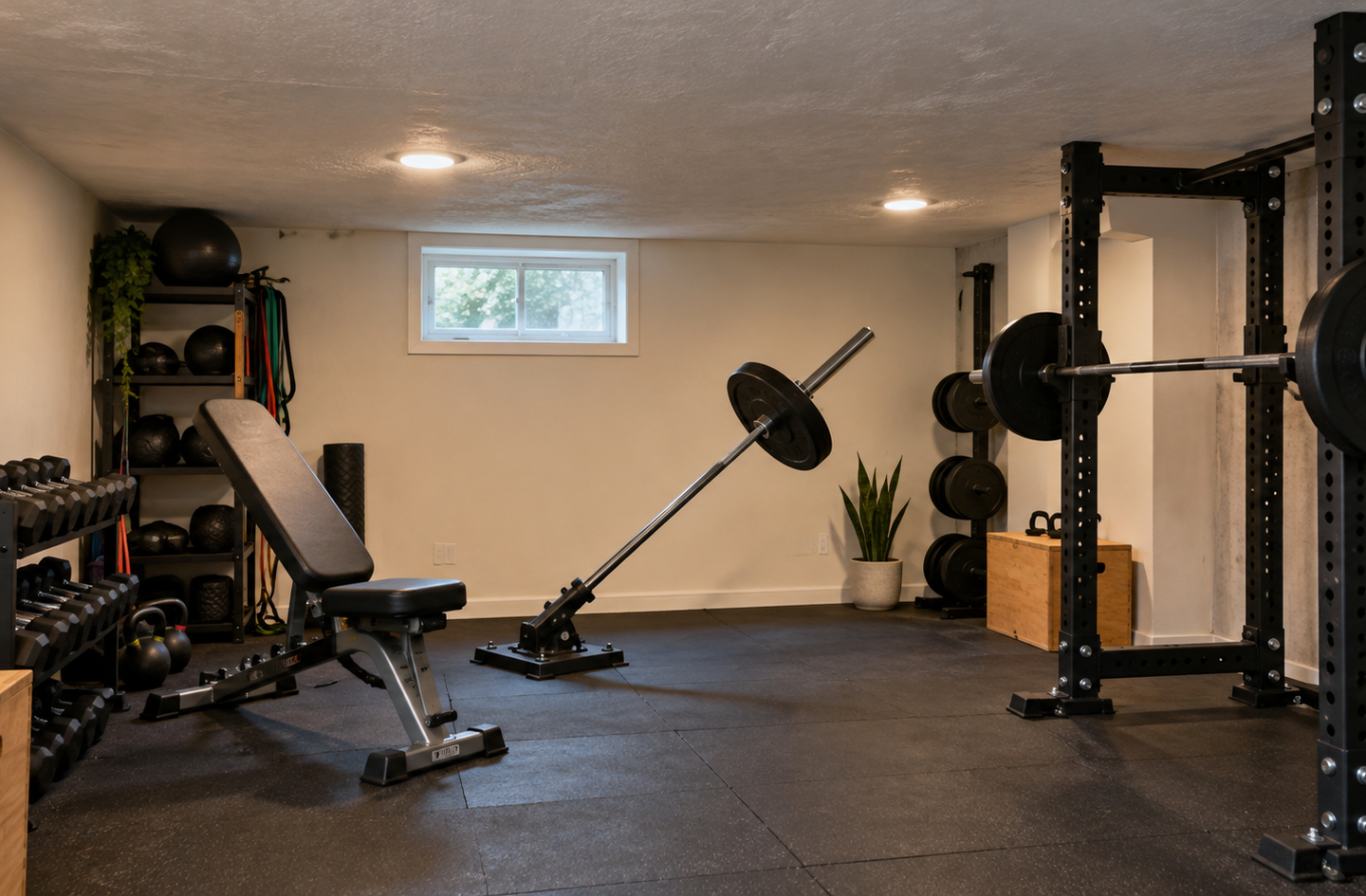
Seven pieces cover squats, presses and pulls in a small room. They are a half rack with safety arms, a room-sized barbell, thin plates, adjustable dumbbells, an upright bench, a pull-up bar and a rubber platform. A men’s competition bar is 220 cm long2, roughly 86.6 inches, so measure the room’s width before buying anything.
Key Takeaways
- A men’s competition bar measures 220 cm, about 86.6 inches2, which is longer than the 7-foot minimum width the residential code allows for a habitable room3. In such a room, the bar must run along the longer wall.
- Dropped weights were the most common injury mechanism in a national study of weight training, at 65 percent of cases1. Safety arms and organized plate storage target that mechanism.
- Thin plates keep a short bar useful as loads climb. With competition-thickness 20 kg discs, even a women’s bar holds about 215 kg before collars2, while thick training plates fill the sleeve sooner.
- The code’s minimum design live load for sleeping areas is 30 pounds per square foot3, so concentrated rack loads on an upper floor deserve a structural engineer’s review.
- The common mistake is buying a full-size rack first. Ceiling height, bar length and the walking path usually set tighter limits than floor area.
What Real Load Asks of a Small Room
Real load means a barbell carrying enough weight that a failed rep cannot simply be dropped or set down by hand. That threshold changes the equipment list completely, because every piece must now protect the lifter, the floor and the walls at the same time. Federal guidance asks adults to lift weights or do other muscle-strengthening work at least 2 days each week4. The room therefore has to work for years of regular sessions.
A small room is smaller than most equipment catalogs assume. Under the residential code, a habitable room needs only 70 square feet of floor area and 7 feet in any horizontal dimension3. The same code sets the minimum habitable ceiling at 7 feet, and basement areas without habitable space can drop to 6 feet 4 inches at beams and ducts3. A spare bedroom or a finished basement corner can sit close to those minimums.
The seven pieces below were chosen because each one keeps a specific lift possible under those constraints. Each entry names what the piece is best for, the dimension that decides whether it fits, and the room check to complete before purchase. The order follows the decision sequence a room-first plan uses: the frame that catches the load first, then the bar and plates, then the accessories that store away.
Treat the code minimums as the planning floor rather than the target, because a room built exactly to them leaves almost no margin for a loaded barbell.
1. A Half Rack With Safety Arms – Best for Squatting and Pressing Alone
A half rack with adjustable safety arms makes heavy squats and presses reasonable without a spotter. It catches the bar when a rep fails. In the national study of weight training injuries, weights dropping on a person were the most common mechanism, at 65 percent of cases1. A frame that intercepts the bar addresses that mechanism before anything else in the room.
Safety arms are horizontal steel members fixed to the uprights just below the lowest point of the bar path. A missed rep then lands on steel instead of the lifter. Facility checklists from the National Strength and Conditioning Association list safety bars alongside belts and collars as equipment to be used and returned5. In a home room, the arms do the job a training partner would do in a commercial gym.
The study’s lead author tied injury risk to equipment instruction and, for younger lifters, to supervision:
“Getting proper instruction on how to use weight lifting equipment and the proper technique for lifts, as well as providing trained supervision for youths engaging in weight training, will also reduce the risk of injury.”1
Dawn Comstock, PhD, principal investigator, Center for Injury Research and Policy at Nationwide Children’s Hospital1
Best for: lifters who train alone and want to squat, bench and press with meaningful weight. A half rack keeps the lifter in front of the frame rather than inside it, which can simplify the layout of a shallow room.
Room check before buying a half rack
Compare the rack’s overall height with the lowest point of the ceiling, including beams, ducts and light fixtures. The residential code minimum ceiling height for a habitable room is 7 feet, or 84 inches3, so a tall rack may not stand upright in a code-minimum room. Freestanding racks with a wide base are the simpler option in a rental or a finished room. Bolting a rack to a slab, a wood floor or a wall changes the load path, and that decision belongs with a licensed contractor or structural engineer.
If only one large piece fits the room, it should be the frame that catches the bar, because heavy squats and presses depend on it.
2. A Barbell Sized to the Room – Best for Fitting Real Load Into a Narrow Space
Bar length is the dimension most small rooms fail first, and it is fixed by the bar rather than by the lifter. The International Weightlifting Federation specifies a men’s bar at 20 kg and 220 cm long, and a women’s bar at 15 kg and 201 cm long2. In inches, that is about 86.6 for the men’s bar and 79.1 for the women’s bar.
Those lengths matter because the residential code allows a habitable room to be just 7 feet, or 84 inches, wide3. A men’s bar is therefore about 2.6 inches longer than a code-minimum room is wide. In a 7-by-10-foot room of exactly 70 square feet, it can only run parallel to the longer wall. A women’s bar fits across the same room with roughly 4.9 inches to spare, which still leaves almost no room for loading plates or stepping around the ends.
The sleeve is the rotating end of the barbell where plates are loaded. On the men’s bar, each sleeve is 41.5 cm long, while each women’s sleeve is 32 cm long2. The shorter bar gives up some loading space, but the plate arithmetic shows it still carries far more weight than most home lifters will use.
Best for: narrow rooms where a full-length bar would leave the lifter stepping sideways around the sleeves on every set. Shorter specialty bars exist as well, but their sleeves and rack fit vary, so confirm that the bar spans the chosen rack’s J-cups and safety arms before buying.
Room check before buying a barbell
Measure the clear width where the rack will stand, wall to wall, at the height of the bar. Commercial facility guidance spaces Olympic bars 3 feet apart between their ends5, which shows how much open space trained staff expect beyond the sleeves. A home room rarely offers that much, so plan at least enough clearance to load a plate and walk past the end of the bar safely.
Choose the bar after measuring the wall it will run parallel to, because a men’s bar cannot run across the narrow side of a code-minimum room.
3. Thin-Profile Plates – Best for Loading Heavy on a Short Sleeve
Plate thickness, not plate weight, decides how much a short bar can carry. Under the federation’s rules, a 20 kg competition disc is at most 5.4 cm wide and a 25 kg disc at most 6.7 cm. Every disc of 10 kg or more is 45 cm in diameter2. Thick training plates of the same weight use up the sleeve much faster.
A thin-profile plate is a weight plate built close to competition thickness for its weight, so more total load fits on each sleeve. Dividing the federation’s sleeve lengths by its disc widths gives a useful planning figure. A 41.5 cm men’s sleeve holds seven 20 kg discs by width, and a 32 cm women’s sleeve holds five2. Before collars, that is roughly 215 kg on the shorter women’s bar.
The 45 cm diameter2 also sets the starting height of a deadlift, because the bar center sits half a plate above the floor. Lighter plates of a smaller diameter lower the bar, so lifters who pull from the floor usually pair full-diameter plates with the heaviest loads.
Room check before buying plates
Plan the storage at the same time as the plates. NIOSH lifting guidance sets a load constant of 23 kg, about 51 lb, as safe for 75% of females and 90% of males under ideal conditions6. A 20 kg plate weighs about 44 lb and a 25 kg plate about 55 lb. Store the heavy plates on a vertical post at roughly waist height, not flat on the floor.
Best for: lifters whose working weights are climbing and whose room cannot accept a longer bar. Storage is safety: a plate post beside the rack keeps the walking path clear and avoids repeated deep bends to the floor.
Buy thinner plates before more plates, because thick training plates and floor storage run out of room sooner than most lifters expect.
4. Adjustable Dumbbells – Best for Replacing a Full Dumbbell Rack
A pair of adjustable dumbbells replaces a full run of fixed pairs, which is usually the single largest floor saving in a small room. A traditional dumbbell rack runs along a wall with a separate pair for every increment. An adjustable pair sits in one cradle about the size of a single pair. That freed wall space can become the plate storage or the walking path.
Best for: rows, lunges, split squats, single-arm presses and accessory work that would otherwise demand several fixed pairs. Unilateral work also suits a narrow room, because one dumbbell moves through less width than a loaded barbell.
The heavier settings bring back the floor-lifting question. Under the NIOSH guidance, 23 kg, about 51 lb, is the load constant for ideal lifting conditions6, and lifting from a low cradle is not an ideal condition. Placing the cradle on a stand at knee or hip height keeps the pickup closer to that guidance.
Room check before buying adjustable dumbbells
Check the cradle’s footprint and the stand’s height against the space beside the bench, and leave a clear lane between them. The NSCA checklist asks for easy access to each bench or area, with a minimum of 2 feet between machines and 3 feet as optimal5. Also confirm how the selector locks, since a loose plate falling during a press is the same kind of dropped-weight mechanism that safety arms address on the barbell side.
Adjustable dumbbells earn their place when floor space is the constraint, but only if the cradle sits high enough to make the heaviest setting easy to lift and return.
5. A Flat-to-Incline Bench That Stores Upright – Best for Pressing and Rows
An adjustable bench that stands on its end when not in use gives a small room flat, incline and seated positions while occupying almost no floor between sessions. The bench is also the simplest answer to a low ceiling, because a seated press moves the overhead lockout much closer to the floor than a standing press does.
The anthropometric figures show the size of that difference. For British adults, the median man’s standing vertical reach is 2100 mm, while his vertical reach while sitting is 1305 mm7. Even after adding the height of the bench seat, a seated press finishes well below a standing one.
Best for: bench pressing inside the half rack, incline work, chest-supported rows and seated overhead pressing in rooms where a standing lockout would meet the ceiling. A bench with a small footprint and wheels at one end is easier to move out of the walking path after each set.
Room check before buying a bench
Measure the bench’s length against the depth in front of the rack. The bench must fit inside the safety arms for pressing and still leave a path behind the lifter. The NSCA checklist asks for easy access to each bench or area, with at least 2 feet between machines and 3 feet as optimal5. Check the stored height too, since an upright bench must clear any shelf or wall-mounted item above it.
In a low room, the bench is not an accessory but the piece that keeps overhead pressing in the program.
6. A Rack-Mounted Pull-Up Bar – Best for Pulling Under a Low Ceiling
A pull-up bar mounted on the half rack is the most space-efficient way to add vertical pulling, because it uses a frame that is already there. Its height is decided by two numbers at once: the lifter’s reach and the ceiling. If the bar sits too high, the head meets the ceiling at the top of each rep. If it sits too low, the feet touch the floor at the bottom.
Vertical reach is the overhead height a raised hand reaches while the person stands, a standard measure in anthropometric tables. In the Roymech anthropometric table, it is 2100 mm for the median man and 2250 mm for a 95th percentile man, or about 82.7 and 88.6 inches7. The median woman reaches 1940 mm, about 76.4 inches7.
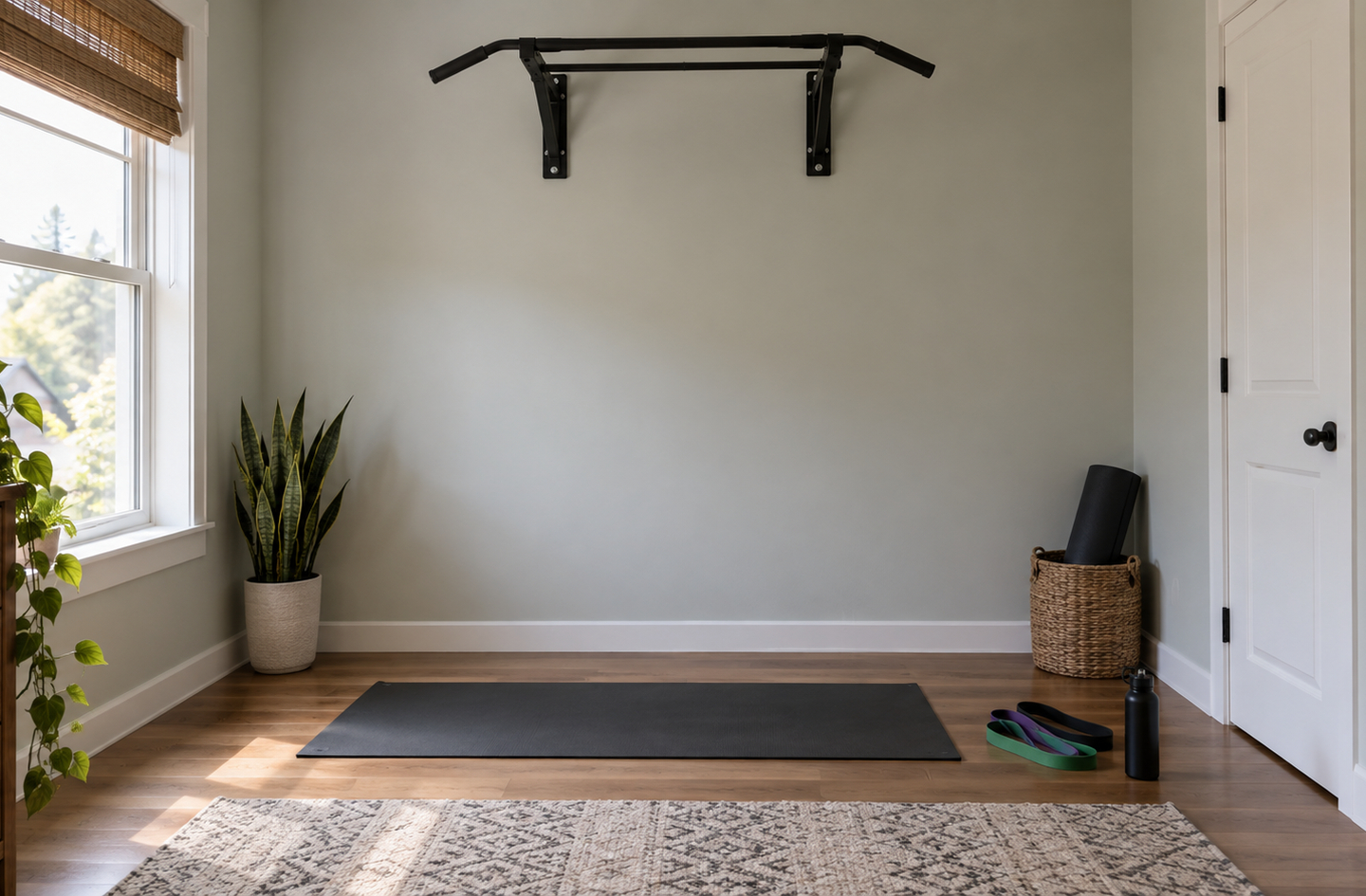
Set against the code minimums, those reach figures explain why pull-ups and standing presses are the first lifts a small room loses. A 7-foot habitable ceiling is 84 inches, and basement areas without habitable space can drop to 6 feet 4 inches, or 76 inches, at beams3.
A 95th percentile man’s bare-hand reach already exceeds a code-minimum ceiling, before a bar or a pull-up is added. Commercial facility guidance asks for at least 12 feet of ceiling for overhead exercises5, which very few small home rooms can offer.
Room check before buying a pull-up bar
Mark the planned bar height and measure from the top of the head to the ceiling at the top of a rep. Then confirm that bent knees clear the floor at the bottom. A rack-mounted bar keeps the load inside the frame. A wall-mounted or ceiling-mounted bar puts dynamic load into the framing. The wall is part of the gym, so have a contractor or structural engineer confirm the framing first.
If the ceiling cannot clear a full pull-up, rows and a lower-mounted bar for assisted variations preserve pulling volume without forcing the room.
7. A Rubber Lifting Platform – Best for Protecting the Floor Under Real Load
A rubber lifting platform, or a layer of heavy stall mats under the rack, protects the floor from dropped plates and spreads point loads from the rack feet. The NSCA facility checklist calls for nonslip mats on the squat rack floor area5, and a home room benefits from the same rule.
Live load is the weight of people, furniture and movable equipment that a floor is designed to carry, as opposed to the weight of the structure itself. The residential code sets a minimum uniform live load of 30 pounds per square foot for sleeping areas and 40 for other areas3. A spare bedroom converted into a gym was most likely designed at the lower figure.
That design figure is spread over the whole floor, while a loaded rack, a lifter and a stack of plates concentrate weight on a few square feet. A platform helps with impact and with spreading the rack’s foot pressure, but it does not raise the capacity of the joists below. For an upper-floor room, or any room carrying a heavy rack and plate collection, a structural engineer should evaluate the specific floor.
Room check before buying a platform
Measure the platform area against the bar length and the rack footprint, so that plates land on rubber rather than on the edge of the mat. A men’s bar at 220 cm, about 86.6 inches2, puts the plates near the ends of a typical platform, so center the bar carefully. Check door swing and threshold height too, because a thick platform can stop a door from opening.
The platform protects the floor surface, but only an engineer can say what the structure underneath will carry.
Small Home Gym Equipment Compared Side by Side
Across the seven pieces, the deciding dimension is rarely floor area. Bar length, sleeve length, ceiling height and floor design load each rule out a different piece, so the table pairs every item with the measurement that decides it. Every figure comes from the sources cited in the entries.
| Piece | Lifts it keeps possible | Deciding dimension | Room check before buying |
|---|---|---|---|
| Half rack with safety arms | Squat, bench press, standing press | Rack height against an 84 in habitable ceiling minimum3 | Lowest beam, duct or fixture above the rack |
| Room-sized barbell | Every barbell lift | 220 cm men’s bar or 201 cm women’s bar2 | Clear wall-to-wall width at bar height |
| Thin-profile plates | Heavy squats and pulls | Sleeve length of 41.5 cm or 32 cm2 | Vertical storage near waist height |
| Adjustable dumbbells | Rows, lunges, single-arm presses | Cradle footprint and pickup height | Stand height and 2 to 3 ft of side clearance5 |
| Upright-storing bench | Bench, incline and seated press, rows | Bench length inside the safety arms | Path behind the bench and stored height |
| Rack-mounted pull-up bar | Pull-ups, chin-ups, hanging work | Reach of 71.3 to 88.6 in, 5th pct woman to 95th pct man7 | Head clearance at the top of a rep |
| Rubber lifting platform | Deadlifts and any heavy set near the floor | 30 psf code-minimum live load for sleeping areas3 | Floor level, door swing and engineer review upstairs |
The table reads in two directions. Down the first column, it is a shopping order; across each row, it is a measuring checklist for the room that has to hold the item. A lifter with a 7-foot ceiling and an 84-inch wall can still keep most of the seven pieces. The bar, the plates and the pressing position simply have to be chosen around those numbers3.
The useful comparison is not which piece is best, but which room dimension rules each piece in or out.
How These Seven Pieces Were Selected
The seven small home gym equipment ideas here started from three lift patterns: a squat, a press and a pull. Each piece had to keep one of them possible under real load in a code-minimum room. Federal activity guidance calls for muscle-strengthening work at least 2 days each week4, so every piece also had to suit regular, long-term use.
Each candidate was judged against four criteria:
- Load capacity: the piece supports barbell or heavy dumbbell loading rather than only light conditioning work.
- Failure handling: a missed rep ends on steel or rubber, not on the lifter or the floor.
- Fit: the deciding dimension can be checked against a 70 square foot room with a 7-foot ceiling3.
- Storage: the piece folds, stands upright or stores vertically, keeping the walking path clear between sessions.
This was a research-only review: no products were tested hands-on, and no brands or prices are compared because both change faster than the room constraints do. Dimensions come from published standards, building codes and anthropometric tables. The page carries no affiliate links and no paid placements.
Frequently Asked Questions
What is the most important piece of small home gym equipment for heavy lifting?
A rack with adjustable safety arms. Weights dropping on a person caused 65 percent of the weight training injuries in a national emergency department study1, and safety arms catch a failed squat or press. Solo heavy squats and presses depend on that frame.
Will a standard Olympic barbell fit in a small room?
Only if the room is wide enough. A men’s competition bar is 220 cm, about 86.6 inches2, which exceeds the 84-inch minimum width of a habitable room, so it must run along the longer wall. A 201 cm women’s bar is shorter, but it still needs clearance at each end for loading.
How high should the ceiling be for pull-ups and overhead presses?
Higher than most small rooms provide. The NSCA facility checklist sets 12 feet as the minimum for overhead exercises5, a commercial benchmark rather than a home rule. A habitable home room can have a 7-foot ceiling. Measure the tallest lifter’s reach with the bar overhead, and switch to seated presses when the standing lockout meets the ceiling.
Can a spare bedroom floor hold a power rack and plates?
It depends on the specific floor. The code sets a minimum live load of 30 pounds per square foot for sleeping areas3, while a rack and plates concentrate weight on a small area. A platform spreads the rack’s foot pressure, but a structural engineer should evaluate an upper-floor room.
Where should plates be stored in a small home gym?
On a vertical post near the rack, at about waist height. The NIOSH load constant is 23 kg, about 51 lb, under ideal lifting conditions6, and a 25 kg plate exceeds it. Waist-height storage avoids deep bends and keeps plates out of the walking path.
Limitations and Edge Cases
- The reach figures describe British adults aged roughly 19 to 65 and were measured without footwear; the actual lifter’s reach should be measured in training shoes.
- Code minimums come from the 2021 International Residential Code as adopted in Utah; local adoption, amendments and older homes vary, and the local building department has the final word.
- Plate-per-sleeve arithmetic uses competition disc maximum widths and ignores collars; many training plates are thicker, so check the actual plate width before relying on the totals.
References
Methodology: every sourced figure links to the page or document that states it. The bar-to-room, plate-per-sleeve and reach-to-ceiling comparisons are Home Gym Specs arithmetic from those values, prepared under the editorial standards of the site founder.
- Nationwide Children’s Hospital – New National Study Examines Weight Training-Related Injuries, news release on Kerr, Collins and Comstock, American Journal of Sports Medicine, March 30, 2010.
- International Weightlifting Federation – Technical and Competition Rules and Regulations 2020, sections 3.3.3 and the bar and disc specification pages, PDF copy hosted by the Indian Weightlifting Federation.
- UpCodes – Utah Residential Code 2021 (International Residential Code 2021), Chapter 3 Building Planning, Sections R301.5, R304 and R305.
- Office of Disease Prevention and Health Promotion – Top 10 Things to Know About the Second Edition of the Physical Activity Guidelines for Americans, U.S. Department of Health and Human Services.
- National Strength and Conditioning Association – NSCA Safety Checklist for Exercise Facility and Equipment Maintenance, PDF.
- Canadian Centre for Occupational Health and Safety – Assessing Lifting Tasks Using the NIOSH Lifting Equation, OSH Answers fact sheet.
- Roymech – Human Sizes: anthropometric data table, 5th, 50th and 95th percentile dimensions for British adults.
Conclusion
Small home gym equipment handles real load when each piece is chosen by the room dimension that limits it. The rack catches the bar, the bar fits the wall, thin plates fit the sleeve, and the bench and pull-up bar respect the ceiling. Measure before you buy, in the order that prevents rework: ceiling before rack, wall before bar, sleeve before plates, floor before platform.
For how these pieces fit the wider lifting area, see the strength zone design overview, which summarizes the planning of the training zone itself.