
A low ceiling treadmill plan is limited by the lowest beam, duct or light fixture over the belt, not by the open ceiling. The runner’s head rides above the deck, not the floor. The 2021 International Residential Code, as adopted in Utah, lets beams and ducts in a habitable basement project to within 6 feet 4 inches of the finished floor1. The cardio equipment placement overview explains where cardio machines sit in a home gym. This guide goes deeper on one question: how much headroom a treadmill needs, and how to check a low room before you buy.
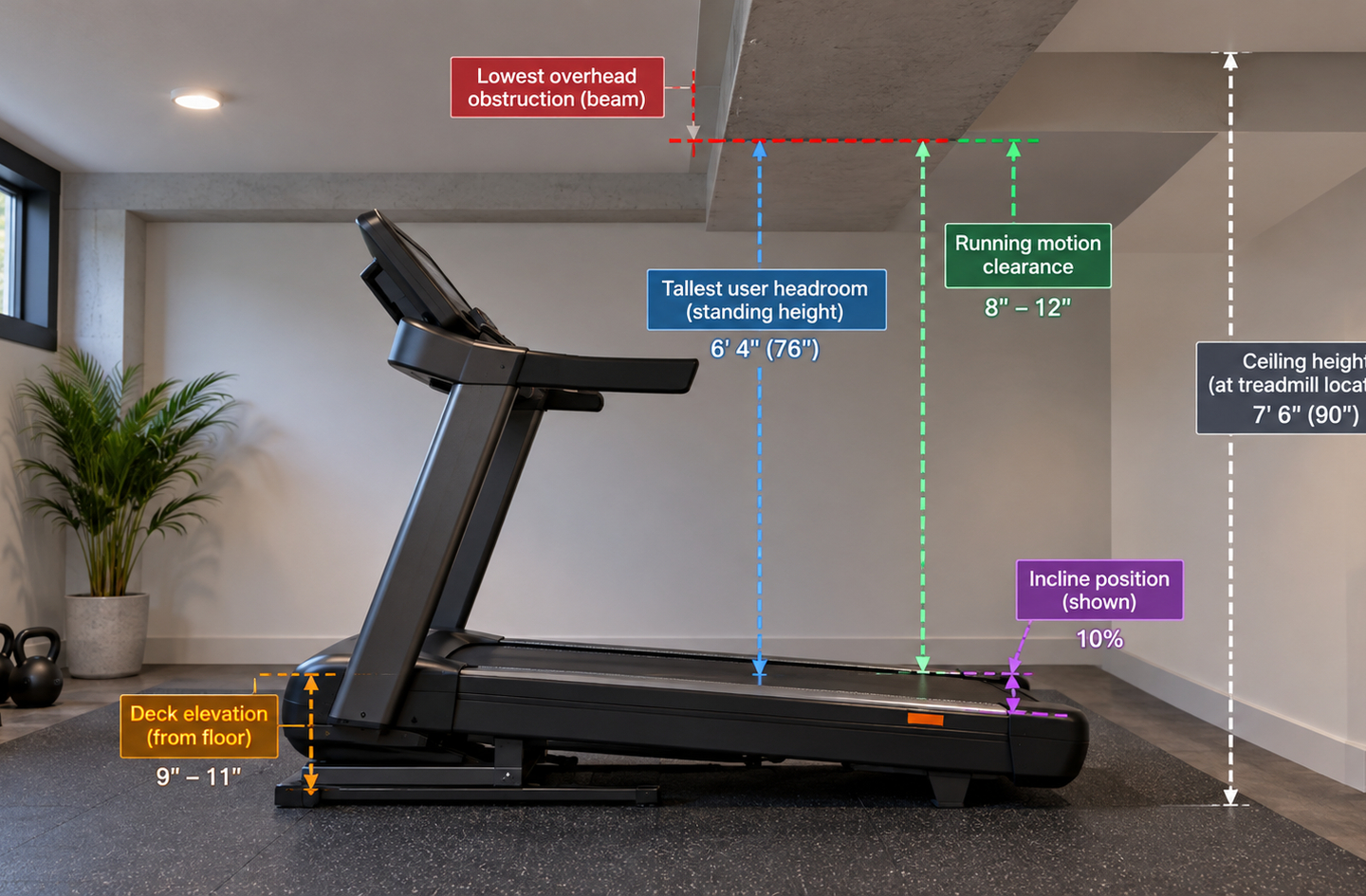
Quick Answer
How much headroom does a treadmill need under a low ceiling?
A treadmill needs room for the tallest user’s height plus the step-up height, incline rise, running bounce and a safety margin. Measure all of it below the lowest obstruction over the belt. Peloton, for one, asks for a ceiling at least 20 inches above the user’s height2. Use whichever is larger, the maker’s rule or your own stack, and hand any structural change to a licensed professional.
- Find the lowest obstruction over the belt.
- Measure the tallest user in running shoes.
- Add the step-up height and any mat.
- Add the incline rise or cap the incline.
- Add a bounce allowance and a safety margin.
- Run the reverse check and decide.
Key Takeaways
- A basement ceiling at the 7-foot code minimum1 meets Peloton’s 20-inch rule2 only for users up to 64 inches tall in shoes. That is just short of the median woman’s 64.02-inch survey stature3.
- The lowest object over the running zone sets the limit: a beam, duct, soffit, light or fan blade, not the room’s typical ceiling height.
- Incline adds height at the front of the deck: roughly 7.4 inches by Home Gym Specs arithmetic for a 59-inch belt at a 12.5% grade2.
- For walking-only plans, Home Gym Specs drops the bounce term, a 9.4 cm mean on video in a 15-runner treadmill study4. The margin and any maker’s rule stay.
- Lowering a floor, rerouting a duct or moving a fan belongs with a licensed contractor, structural engineer, electrician or HVAC specialist.
How the Treadmill Headroom Stack Works
Treadmill headroom is a stack of five terms that must fit under the lowest obstruction above the belt. The terms are the user’s height, the step-up height, the incline rise, a bounce allowance and a safety margin. Headroom is the clear vertical space between the top of a runner’s head and the lowest object above it. A low room works when the stack stays below that object at every setting you plan to use.
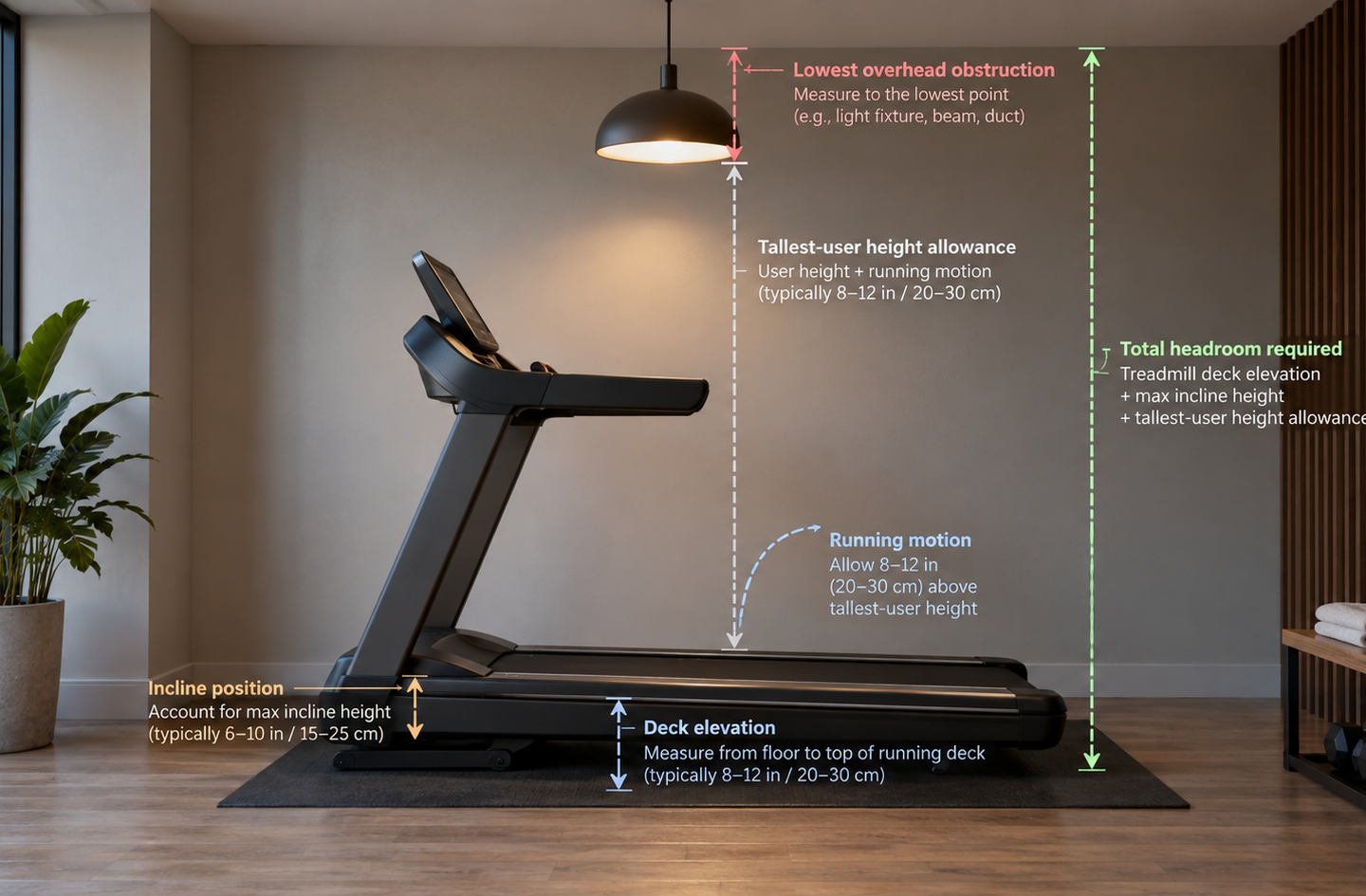
Each term comes from a different place. The obstruction is measured in the room, the user is measured in shoes, and the deck figures come from the maker’s specification sheet. The bounce allowance comes from running research, and the margin is a planning choice that covers what the research cannot.
| Term | What it measures | Example value and source |
|---|---|---|
| Lowest obstruction | Floor to the lowest beam, duct, light or blade over the belt | Habitable basement ceiling of 7 feet; beams down to 6 feet 4 inches1 |
| User height | Tallest user, standing, in running shoes | Median U.S. Army man 69.09 in, survey stature3 |
| Step-up height | Floor to the top of the belt at 0% incline | Peloton Tread Flex 8 in; Tread+ Vision 11 in2 |
| Incline rise | Extra height at the front of the belt at the top grade | About 7.4 in on a 59 in belt at 12.5%, Home Gym Specs arithmetic2 |
| Bounce and margin | Up-and-down travel per stride plus a planning buffer | Video mean 9.4 cm, about 3.7 in4, plus a 4 in Home Gym Specs margin |
If a maker publishes its own ceiling rule, that rule is the floor for its machine; the stack only matters when it comes out larger.
Before You Begin: What to Gather
A treadmill headroom check needs a measuring tool, a helper and the machine’s specification sheet. Gather these before you start:
- A tape measure or a laser distance meter, plus a level or plumb line.
- A stepladder, so you can reach joists, ducts and soffits safely.
- The treadmill’s specification sheet: step-up height, belt length, top incline and any ceiling rule the maker states.
- The tallest regular user, wearing the shoes they run in.
- Painter’s tape to mark the belt’s outline on the floor.
Time: under half an hour. Difficulty: beginner. No tools touch the structure, and nothing is cut or fastened.
Read the power line on the same sheet while you have it. Peloton, for example, asks for a dedicated, grounded circuit capable of carrying 15 or more amps2. Whether the outlet nearest the low spot meets that is a question for a licensed electrician, not a tape measure.
Step 1: Find the Lowest Obstruction Over the Belt
The lowest object above the running zone, not the room’s typical ceiling height, is the number every later measurement is compared against. The 2021 International Residential Code, as adopted in Utah, sets at least 7 feet for habitable basement space1. Beams, girders and ducts may still project to within 6 feet 4 inches of the floor1. Basement areas without habitable space can sit at 6 feet 8 inches1.
“Beams, girders, ducts or other obstructions in basements containing habitable space shall be permitted to project to within 6 feet 4 inches (1931 mm) of the finished floor.”1
International Code Council, 2021 International Residential Code as adopted in Utah, Section R305.1, via UpCodes1
That exception is why a basement can meet code and still fail a treadmill check. The lowest obstruction is the single lowest point of anything above the belt’s footprint, including ducts, pipes, soffits, light fixtures, sprinkler heads and drop-ceiling grids.
- Set the treadmill’s outline on the floor with painter’s tape, using the footprint on its specification sheet.
- Plumb up from the front, middle and rear of the belt, and from both side rails.
- Measure from the finished floor to the underside of every object in that column of air.
- Record the lowest reading in inches. That figure is the ceiling for the rest of the check.
Sloped attic and bonus-room ceilings
A sloped ceiling can pass code while most of the floor is too low for running. The same code section lets a sloped room’s required floor area fall to 5 feet, provided not less than 50 percent of it has at least 7 feet1. Put the belt under the highest strip of ceiling, then measure the slope at the front and rear of the deck, because the lower end decides the check.
Ceiling fans and light fixtures
A ceiling fan counts as an obstruction, and a moving one is the worst kind. The Hawaii State Energy Office says ceiling fans should hang at least 7 feet above the floor5. A blade at that minimum sits below the ceiling Peloton’s 20-inch rule2 sets for a median-height man in the NC State data3. Keep the treadmill outside the fan’s sweep, and leave moving a fan or light fixture to a licensed electrician.
Measure the column of air over the belt, not the middle of the room; one duct crossing the deck decides the whole check.
Step 2: Measure the Tallest User in Running Shoes
The tallest person who will run on the machine sets the user term, and that person should be measured standing in running shoes. NC State’s summary of U.S. Army survey data puts adult male stature at 64.88, 69.09 and 73.62 inches at the 5th, 50th and 95th percentiles3. For women the same table lists 60.04, 64.02 and 68.50 inches3.
Those survey figures are a reference range, not a substitute for a tape measure. Stand the user against a wall in their running shoes, lay a book flat on their head, mark the wall and measure to the floor. Include anyone who might use the machine later, such as a teenager who is still growing or a tall guest.
Some makers also cap user height. Peloton lists a height range of 4 feet 11 inches to 6 feet 4 inches for its treadmills2. Under Peloton’s own 20-inch rule2, its tallest permitted user, at 76 inches, needs a 96-inch ceiling, which is 8 feet.
Plan for the tallest user and the shoes they wear, because the shortest margin in the household is the one that matters.
Step 3: Add the Step-Up Height and Any Mat
The step-up height lifts the runner before any incline is added, and it runs from 8 to 11 inches across Peloton’s current treadmills2. Step-up height is the distance from the floor to the top of the running belt at a flat setting. Peloton lists 8 inches for the Tread Flex and Tread Vision and 11 inches for the Tread+ Vision2.
A floor mat or a layer of rubber flooring raises the whole machine by its own thickness. Add that thickness to the published step-up height. If the machine is already home, measure it on its mat, from the floor to the top of the belt at the rear roller. The guide to a treadmill mat for hardwood floors covers mat sizing and placement.
If the specification sheet gives no step-up height, measure an assembled machine in a store or ask the maker for the figure in writing. Do not estimate it from a product photo.
A 3-inch difference in deck height between two models can decide a low room, so compare step-up heights before you compare motors or screens.
Step 4: Add the Incline Rise or Cap the Incline
Incline lifts the front of the deck, and on a 59-inch belt at a 12.5% grade the front end rises roughly 7.4 inches2. Grade is rise over horizontal run, written as a percent. Belt length times grade slightly overstates the rise, which keeps the estimate conservative.
The rise is the belt length multiplied by the top grade. Peloton lists a 59-inch belt and an incline of 0 to 12.5% grade for the Tread Flex and Tread Vision2. The Tread+ Vision has a 67-inch belt and inclines to 15%2. By Home Gym Specs arithmetic, that gives about 7.4 inches and 10 inches of front-end rise.
The runner’s feet land behind the front roller, so the front-end figure overstates the rise under the head. Home Gym Specs uses it anyway as a conservative bound, because the exact foot position changes with stride and speed.
- Find the belt length and top grade on the specification sheet.
- Multiply them to get the front-end rise in inches.
- Decide the highest grade you will actually run at. Use that lower grade only if every user will keep to it; otherwise check at the top grade.
Capping the incline is the cheapest fix in a low room. Every grade you give up shrinks the stack, until the maker’s rule becomes the larger figure.
Step 5: Add a Bounce Allowance and a Safety Margin
Running moves the body up and down on every stride. Video analysis in a 2022 treadmill study measured a mean vertical oscillation of 9.4 cm, about 3.7 inches4. Vertical oscillation is the up-and-down travel of a runner’s body during each stride. In that study, fifteen participants ran at five different self-selected speeds4.
Runners differ widely. A 2017 study of ninety-seven endurance runners found that some runners showed more than twice the vertical oscillation of others6. Fatigue adds more, as a 2016 Sports Medicine review notes:
“Additionally, vertical oscillation increases when running to exhaustion.”7
Isabel S. Moore, Cardiff Metropolitan University, Sports Medicine7
The same review reports that female runners show lower vertical oscillation than male runners7. For planning, Home Gym Specs uses the 3.7-inch mean as the head-bounce allowance4, knowing that a high-bouncing runner can exceed it.
Then add a separate safety margin of 4 inches. That margin is a Home Gym Specs planning choice, not a measured value, meant to absorb higher-bouncing runners, late-session fatigue, hair and caps. It is a planning buffer, not a safety guarantee.
Walking instead of running
Walking has no flight phase, so Home Gym Specs drops the bounce term for a walking-only plan, as a planning assumption. The safety margin stays for stumbles, hair and caps. It does not cover a raised arm, so keep fans and fixtures out of reach above the deck. Any ceiling rule the maker states also stays in force.
Never plan a low ceiling treadmill setup with zero margin. A head that clears the beam on an easy run may not clear it after a hard one.
Step 6: Run the Low Ceiling Treadmill Reverse Check
The reverse check subtracts every allowance from the lowest obstruction and leaves the tallest user who fits, which is easier to judge than a long sum. Subtract the step-up height, the incline rise, the bounce term and the margin from the obstruction height, then compare the result with the measured user. If the machine’s maker states a ceiling rule, also subtract that allowance and keep the smaller result.
Worked example, calculated from cited inputs: a Peloton Tread Flex in a basement at the 7-foot (84-inch) habitable minimum1. Its maker asks for a ceiling 20 inches above the user’s height2.
- Running flat, own stack: 8 in step-up2 + 3.7 in bounce4 + 4 in margin = 15.7 in. That is below the maker’s 20 inches, so the maker’s rule governs: 84 – 20 = 64 in, or 5 feet 4 inches.
- Running at the 12.5% top grade2: 8 + 7.4 + 3.7 + 4 = 23.1 in. That exceeds 20 inches, so the stack governs: 84 – 23.1 = 60.9 in, just over 5 feet.
- Under a beam at the 6-foot-4-inch (76-inch) exception1: 76 – 20 = 56 in running flat, and 76 – 23.1 = 52.9 in at the top grade.
Result, calculated: NC State’s median woman stands 64.02 inches before shoes3, already 0.02 inches over the 64-inch limit, and shoes widen the gap. Under the beam, all six percentiles listed in the NC State table are too tall, down to the 5th-percentile woman at 60.04 inches3.
The same subtraction works for any treadmill with a published step-up height and belt length. Swap in its figures, keep the bounce term for running and drop it for walking, and keep the margin in every case. Between two shortlisted models, the lower deck and lower top grade leave more room for the user. That holds unless the maker states a larger ceiling rule.
Peloton’s 20-inch rule2 turns NC State’s stature percentiles3 into a minimum ceiling for each user. By Home Gym Specs arithmetic, that comes to about 80 inches for a 5th-percentile woman, 84.02 for a median woman and 89.1 for a median man.
On a Tread Flex, a 7-foot room fits users up to 5 feet 4 inches in shoes running flat, or just over 5 feet at full incline. A Tread+ Vision at 15% leaves 55.3 inches, below Peloton’s own minimum user height of 4 feet 11 inches2.
Common Headroom Mistakes in a Low Room
The most expensive mistakes in a low room come from measuring the wrong thing, not from measuring badly. Each one below leaves out a term of the headroom stack or measures it in the wrong place.
Measuring the room instead of the running zone
A ceiling that reads 7 feet 6 inches at the center can drop to a duct or soffit right above the belt. The fix is to plumb up from the belt’s own footprint and record only the lowest point there.
Planning for the average user
A household’s median height says nothing about its tallest runner. Measure the tallest person who will use the machine, in shoes, and size the check to them.
Forgetting the mat and the incline
A mat adds its thickness under the whole deck, and the top grade adds height at the front. Both belong in the stack, even if the incline is used once a week.
Treating the maker’s rule as optional
A maker’s ceiling rule is its stated minimum for its own machine. If your stack comes out smaller, the maker’s figure still applies; if it comes out larger, use yours.
What a Passing Headroom Check Looks Like
A passing check ends with one written line. It records the lowest obstruction height, the stack for the tallest user at the highest planned grade, and the margin left over. If the reverse check gives a user height above the tallest person who will use the machine, the room passes for that machine and that use. This is a planning check, not a safety or code certification.
A failing check is still useful, because the term that pushed it over points to the fix. If the machine folds, its raised deck also has to clear the ceiling, which the guide to treadmill fold and store space covers.
| If the check fails because… | Do this |
|---|---|
| The incline term pushes it over | Cap the incline at the grade that fits, or plan flat runs and incline walks |
| A beam or duct crosses the belt | Shift or rotate the machine so no beam or duct crosses the belt’s footprint, while keeping the maker’s rear and side clearances |
| The deck or mat is too tall | Compare a thinner mat or a model with a lower published step-up height |
| The tallest user still does not fit | Walking lowers your own stack but not a maker’s ceiling rule; plan walking only if the room passes that rule, or choose another cardio machine |
| Only a structural change would fix it | Bring in a licensed contractor, structural engineer, electrician or HVAC specialist |
Another cardio machine is not automatically lower. An elliptical’s pedals lift the body on every stride, so check elliptical space needs before treating one as the low-ceiling answer. A seated rower keeps the head far lower in use, though storing it upright brings its own ceiling check in rowing machine storage.
Keep the passing line with the receipt, and rerun the check when a taller user or a thicker mat arrives.
Frequently Asked Questions
How much ceiling height do you need for a treadmill?
You need the tallest user’s height plus step-up height, incline rise, running bounce and a margin, measured to the lowest obstruction over the belt. Peloton sets its own minimum at 20 inches above the user’s height2. On its machines, a 6-foot runner needs at least 92 inches, or 7 feet 8 inches, running flat, and more at full incline.
Can you put a treadmill in a basement with a low ceiling?
Sometimes, if both the maker’s rule and your own stack pass under the lowest beam. The 2021 IRC as adopted in Utah allows habitable basement ceilings of 7 feet with beams and ducts down to 6 feet 4 inches1. Run the reverse check under the lowest beam over the belt, and shift the machine if one crosses the running zone.
Does treadmill incline need more ceiling height?
Yes. Incline raises the front of the deck by roughly the belt length times the grade. On a 67-inch belt at a 15% grade, that comes to about 10 inches by Home Gym Specs arithmetic2. Capping the incline shrinks the stack without changing the room, until the maker’s rule becomes the larger figure.
Do you need less ceiling height to walk on a treadmill than to run?
Often, on your own stack. Home Gym Specs drops the running bounce for walking-only plans, a 9.4 cm mean in a video-measured treadmill study4. The safety margin stays, and any ceiling rule the maker states still applies. A walking-only plan can suit a room that fails the running check.
Can a treadmill go under a ceiling fan?
Keep the belt outside the fan’s sweep. The Hawaii State Energy Office gives 7 feet above the floor as the minimum fan height5. That is lower than many runners need: Peloton’s rule, for one, sets 89.1 inches for a median-height man23. Leave moving a fan to a licensed electrician.
Limitations and Edge Cases
- Peloton’s 20-inch rule and deck figures describe Peloton’s own treadmills2. Another maker’s published figures govern its machine, and a model without them needs measured values.
- The NC State figures summarize the 2012 Anthropometric Survey of U.S. Army Personnel3, so they set a reference range for planning, not any one user’s height.
- The bounce figures come from laboratory samples, fifteen runners in the video study4. The safety margin is a planning buffer for faster, higher-bouncing or tired runners, not a guarantee.
- The code figures are the 2021 IRC as adopted in Utah1. Local adoption varies and older basements may sit lower, so a local building official can confirm what applies. Home Gym Specs applies Peloton’s ceiling rule to the lowest obstruction as a conservative reading.
Home Gym Specs guidance is engineering-informed, not engineering-certified. Lowering a slab, rerouting a duct, moving a light or opening a ceiling affects structure, ventilation or wiring. Bring in a licensed contractor, structural engineer, electrician or HVAC specialist for that specific case.
References
Methodology: each sourced figure links to the document that states it, and every source was re-checked on October 21, 2026. The inch conversions, incline rises, headroom stack, worked example and chart values are Home Gym Specs arithmetic from those documents, without hands-on product testing.
- UpCodes – Utah Residential Code 2021, which adopts the International Residential Code 2021 (IRC 2021) with amendments, Chapter 3 Building Planning, Sections R305.1 Minimum Height and R305.1.1 Basements.
- Peloton – Treadmills comparison page, Measurements, User requirements, Space recommendations and Performance rows for the Tread Flex, Tread Vision and Tread+ Vision, read October 2026.
- NC State University Ergonomics Center – Anthropometric Data for U.S. Adults, summary tables in inches from the 2012 Anthropometric Survey of U.S. Army Personnel (Gordon et al. 2014), PDF.
- PLOS ONE – The validity and reliability of wearable devices for the measurement of vertical oscillation for running, Smith, Fullerton, Walton, Funnell, Pantazis and Lugo, November 2022, via PubMed Central.
- Hawaii State Energy Office – Ceiling Fans factsheet, Ceiling Height section, PDF.
- Medicine and Science in Sports and Exercise – Running Technique is an Important Component of Running Economy and Performance, Folland, Allen, Black, Handsaker and Forrester, July 2017, via PubMed Central.
- Sports Medicine – Is There an Economical Running Technique? A Review of Modifiable Biomechanical Factors Affecting Running Economy, Isabel S. Moore, Cardiff Metropolitan University, January 2016, via PubMed Central.
Conclusion
A low ceiling treadmill decision comes down to one subtraction. The lowest obstruction over the belt, minus the larger of the maker’s allowance or the four stack allowances, has to exceed the tallest user in shoes. Measure before you buy, cap the incline before you rebuild anything, and hand structural changes to a professional.
See the cardio equipment placement overview for where a treadmill fits among the other cardio machines in the room.